Women with hip arthritis are seeing real change in pain they were told was simply “wear and tear”.





For as long as most women can remember, hip arthritis has been explained with one picture: the X-ray.
“Wear and tear.” “Bone on bone.” “You’re too young for a replacement — come back when it’s bad enough.” The same short list of answers, handed to millions of women whose hip stabs the moment they stand up from a chair — all of them built on one assumption: that if the pain is in the hip, the problem must be the cartilage, and the only real fix is a new joint someday.
But that never explained why two women with the same X-ray live completely different lives. One walks the dog every morning. The other holds on to the kitchen counter to take her first steps. Something else has to be going on.
Researchers have been looking at that “something else” for over a decade.
And what they found doesn’t live in the bone at all. It lives in the muscles that are supposed to hold the hip steady — muscles that, once the joint starts to hurt, quietly stop doing their job. It was never visible on an X-ray, because an X-ray was never designed to show whether a muscle is switching on.
Once that is understood, hip arthritis stops looking like a joint that is simply wearing out — and starts looking like something with a second cause, and a real path forward.

What the Research Actually Found
There is a reason the X-ray never explained the pain — and it is not the reason women were given.
An X-ray looks at bone. It shows the space between the ball and the socket. It can say the cartilage is thinner. That is all it was built to do.
It was never built to show the muscles wrapped around the hip — or whether they are still firing.
Most women with hip arthritis have already been told what’s wrong. That the cartilage is wearing down. That the joint is stiff and inflamed. That it hurts more after sitting, in the morning, on the stairs.
All of that is true.
What nobody told them is what that weakness does. Why the limp started. Why getting out of the car got harder. Why the pain moved to the side of the hip, the groin, the front of the thigh.
The answer is a muscle called the gluteus medius — the fan-shaped stabilizer on the outside of the hip.
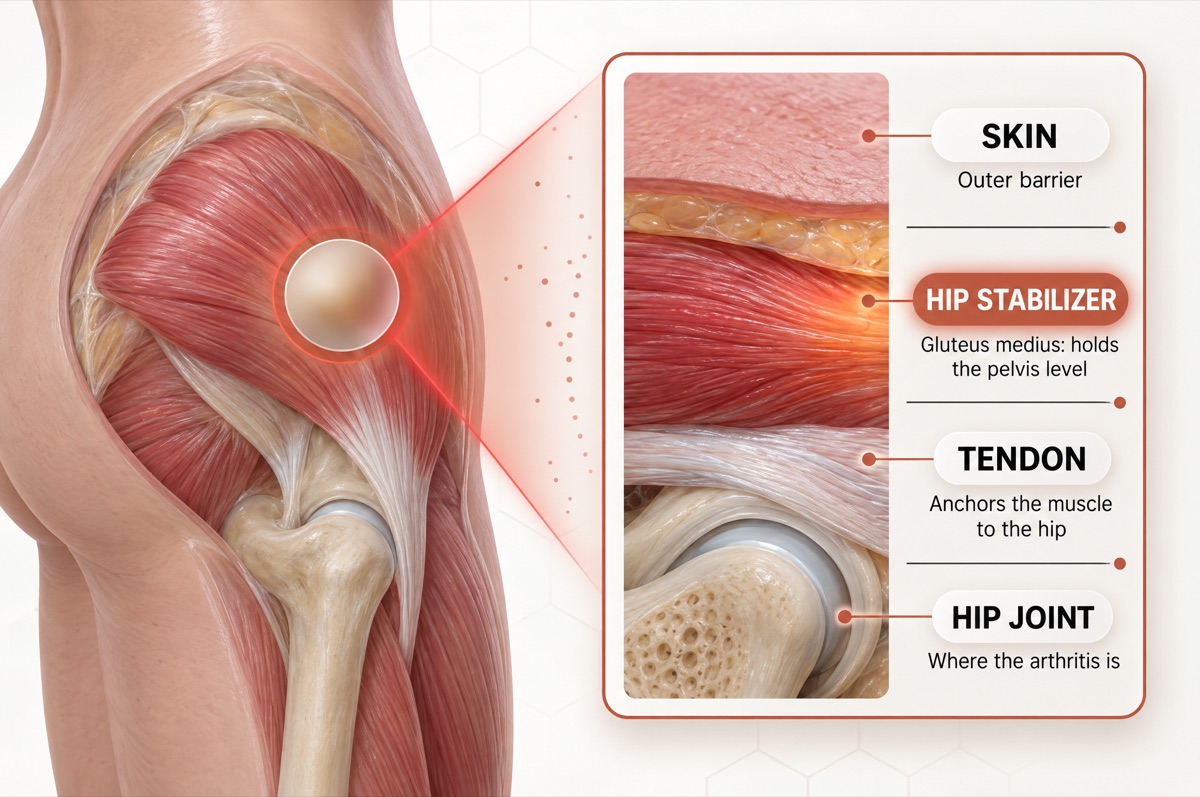
Every time one foot leaves the ground, this muscle fires on the other side and holds the pelvis level. Thousands of times a day. On every step, every stair, every time you stand up. In a healthy body it works so quietly that nobody ever thinks about it. It is invisible by design.
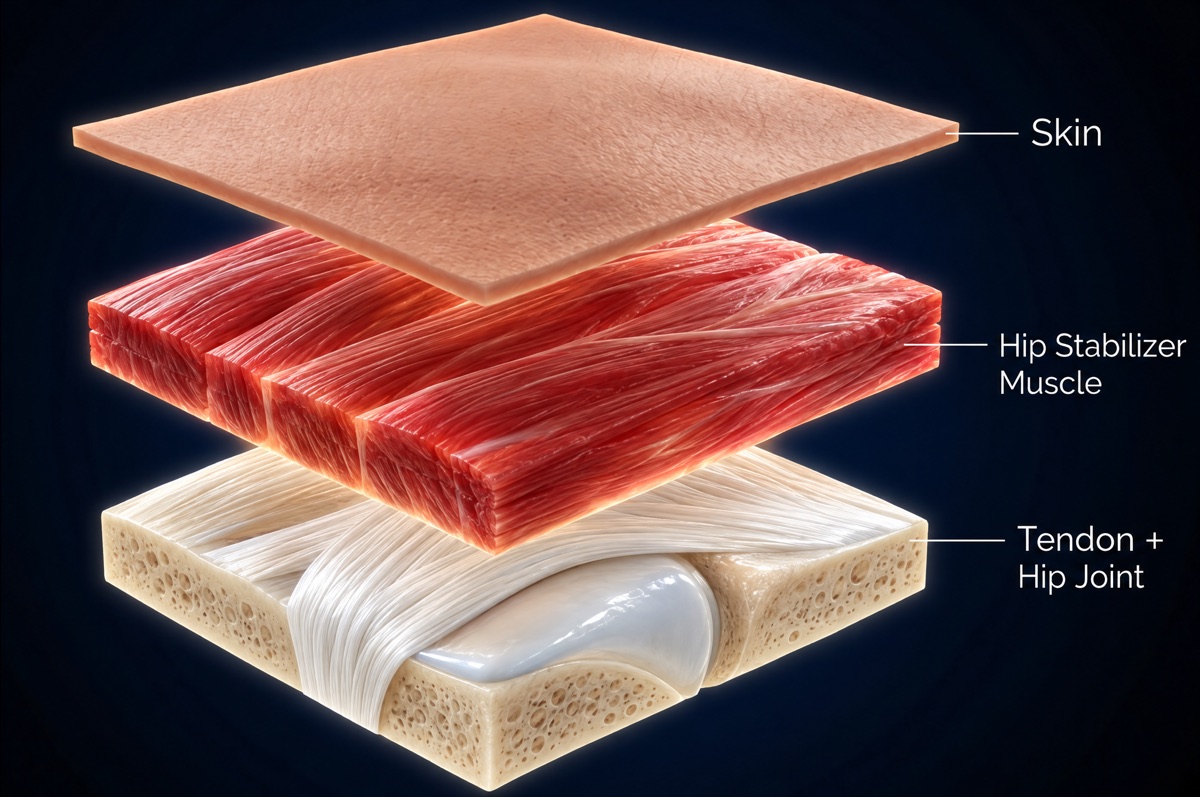
Two things about these muscles matter more for hip arthritis than anything else.
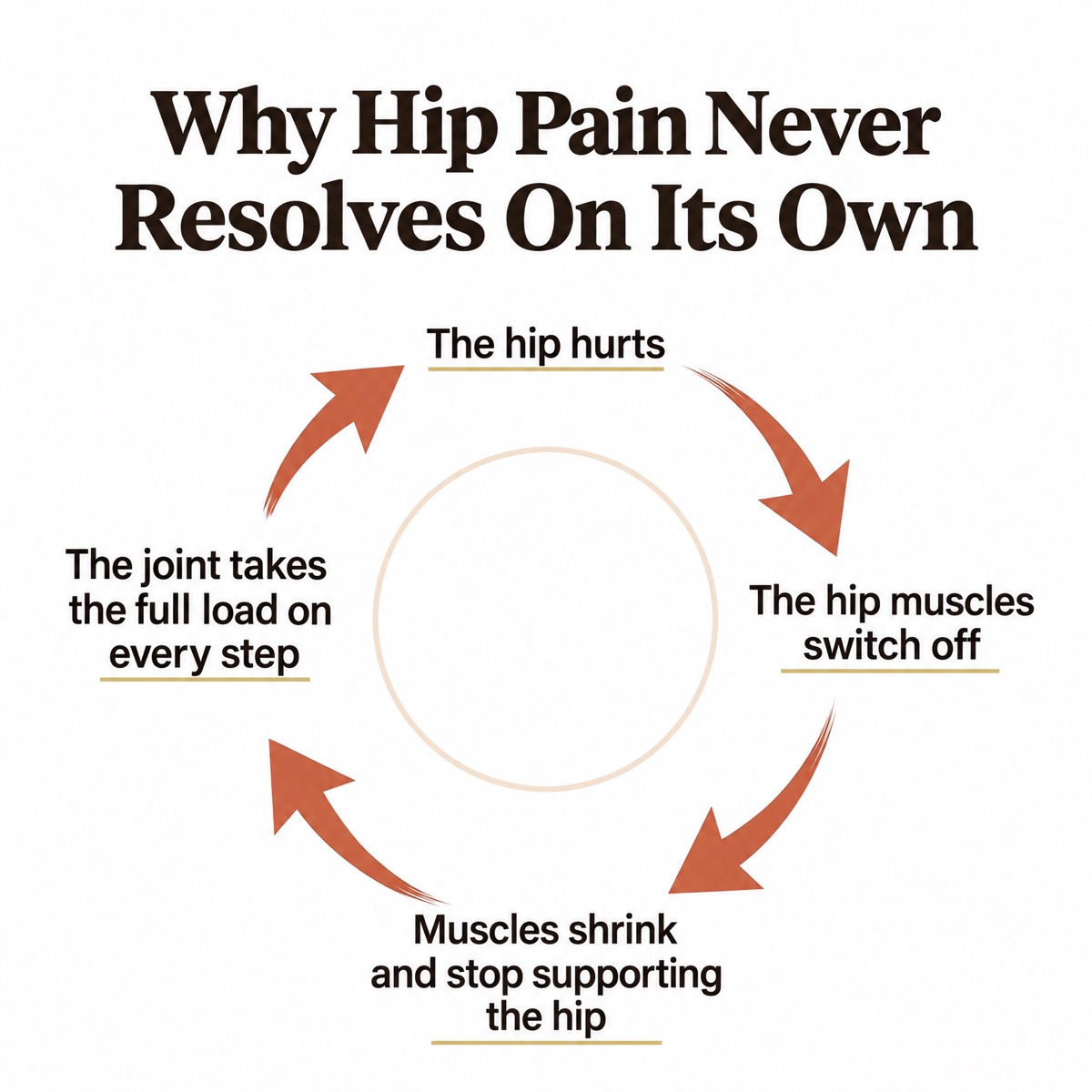
First: when a joint hurts, the nervous system turns the muscles around it down. Researchers call it arthrogenic muscle inhibition — the joint sends altered signals, and the muscles that should protect it stop receiving the full command to fire.
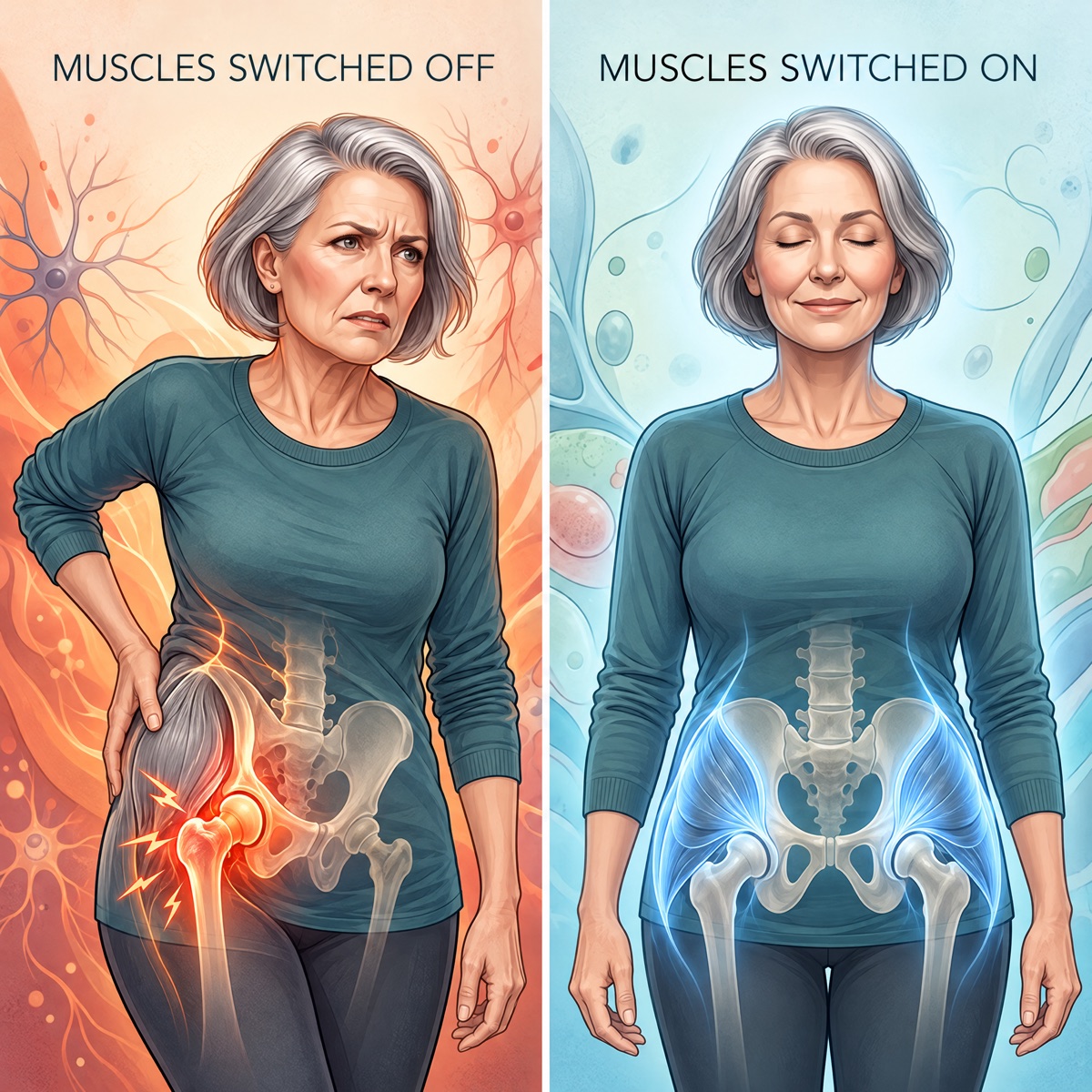
Second: a muscle that doesn’t fire doesn’t stay the same. It shrinks. And when the stabilizer shrinks, the joint it was protecting takes the full load on every single step.
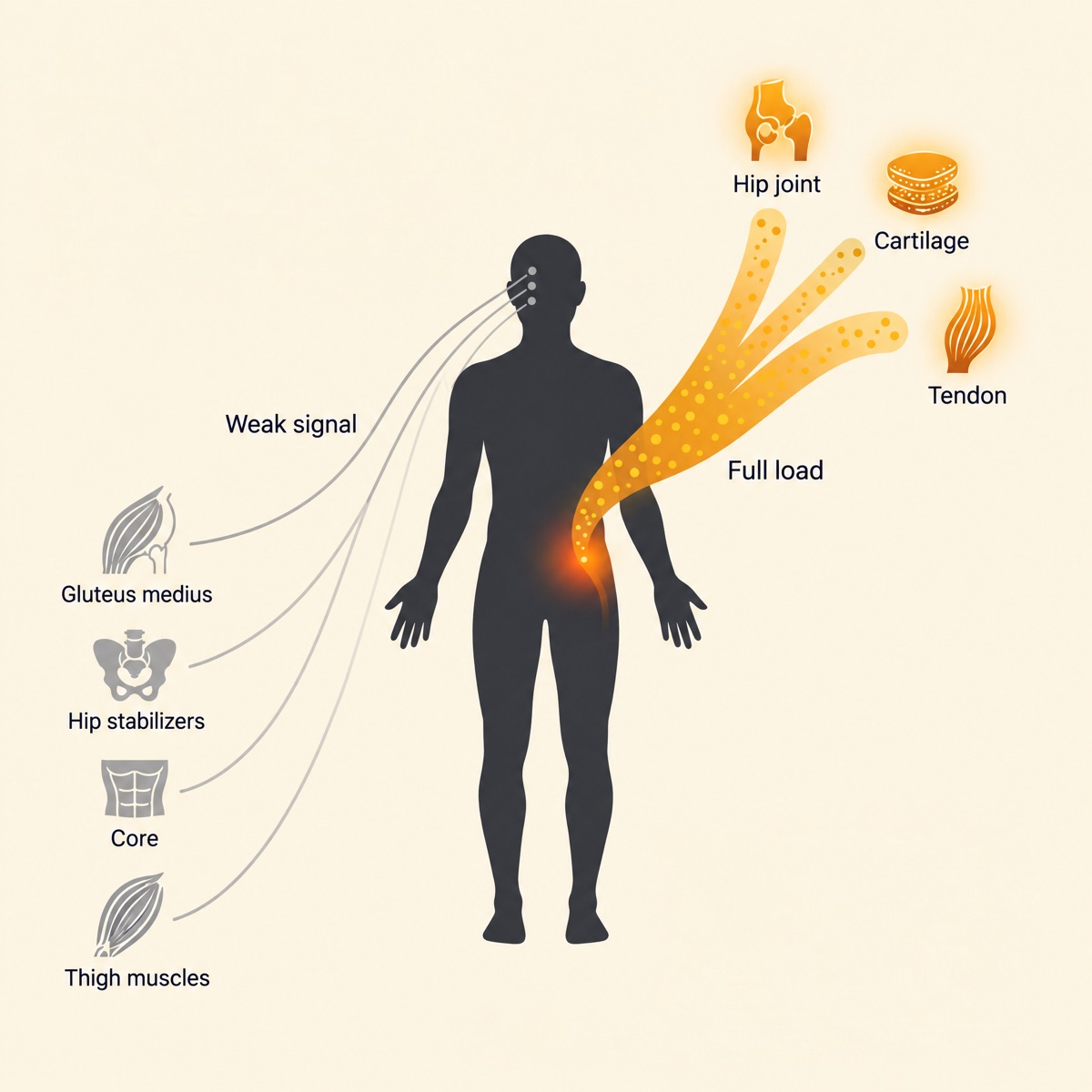
And that is where the circle closes.
The hip hurts, so the muscles switch down. The muscles switch down, so the joint takes more load. The joint takes more load, so it hurts more. Month by month, the muscles that should be holding you up go quiet — and the pain gets worse for a reason no X-ray will ever show.
We call it a Hip Muscle Lockout. The stabilizers aren’t gone. They are locked out — still there, still able to work, but no longer answering on their own.
Why Every Symptom Finally Makes Sense
Once the lockout is understood, every symptom of hip arthritis — the ones that seemed random, the ones you were told are just age — starts to fit together. Not as a list of unrelated problems. As one problem, showing up in a dozen places.
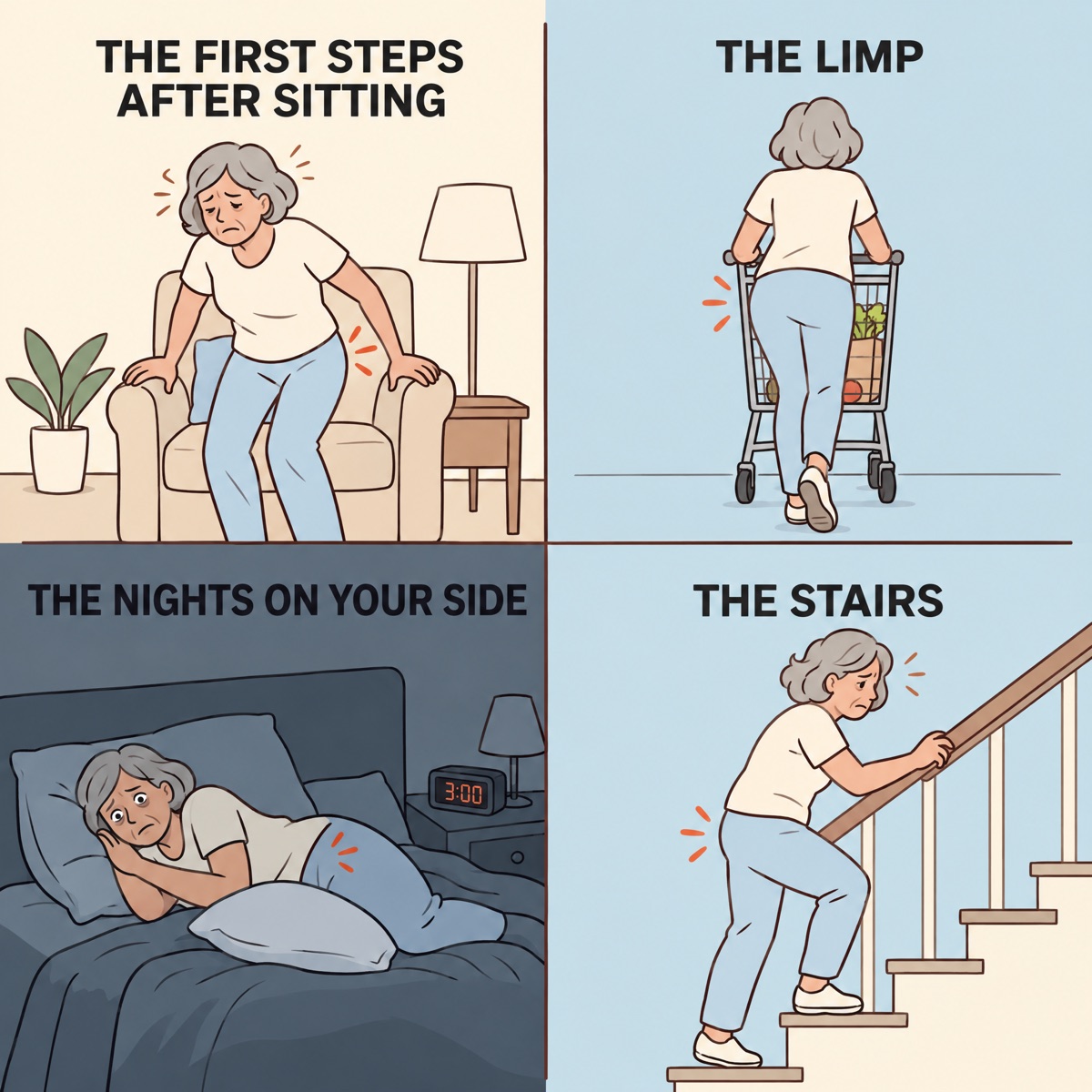
When you stand, the stabilizers are supposed to switch on before you even move. In a locked-out hip, they switch on late — or barely at all. So the joint takes the shock alone until the muscles “warm up.”
The gluteus medius keeps the pelvis level on every step. When it stops firing, the pelvis drops and the body leans to compensate. That lean is the limp — and it puts even more load through the joint.
Lying on your side puts pressure right over the outer hip — over the exact muscles that have gone quiet and the tissues they were supposed to protect.
Every stair is a moment on one leg. With the stabilizer locked out, the joint carries the whole body on its own — and the knee and back start paying for it too.
For years, women with hip arthritis have been told it’s age. Told to lose weight. Told to take the pills, get the shot, and wait until it’s “bad enough” for surgery. Told their X-ray explains everything — while nobody checked whether the muscles were still working.
Now every symptom above is explained by the same finding — the muscles that hold the hip steady, locked out and shrinking.
Not a mystery. Not just “getting old.” Not something you have to learn to live with.
One group of muscles, in one state, producing everything you have been living with — and everything you have been trying to explain to the people around you — for years.
Why Nothing on the Standard Shelf Has Ever Lasted
Most women who have had hip arthritis for any length of time have cycled through the standard shelf.
Advil, morning and night. Voltaren gel. Osteo Bi-Flex. A TENS unit from the pharmacy. The cortisone shot — then the second, then the third. A physical therapy sheet of bridges and clamshells. A pillow between the knees at night. And, some days, the cane. And the surgery brochure, “for when you’re ready.”
And every one comes with the same pattern. A few good weeks. Then it wears off, and back to where things started.
The reason is simple: almost every one of them works on the pain signal.
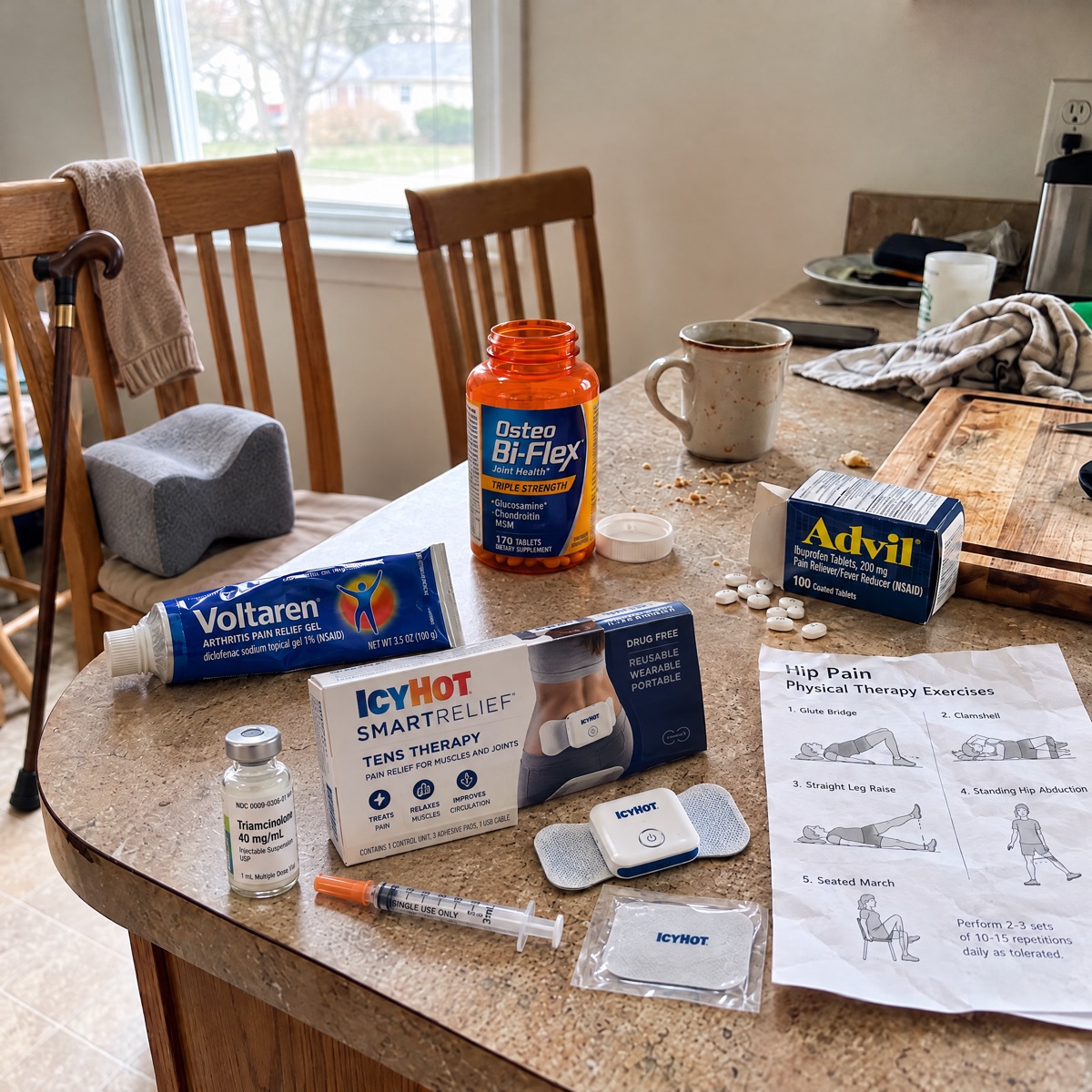
Pills and gels dull the pain. Glucosamine is aimed at the cartilage. A TENS unit buzzes over the nerve to mask the signal. The shot calms the inflammation for a few weeks. None of them make a locked-out muscle fire. Physical therapy is the one thing aimed at the muscles — but it asks a switched-off muscle to switch itself back on, and when the visits end, the exercises usually end too. And a replacement changes the joint; it doesn’t switch the muscles back on.
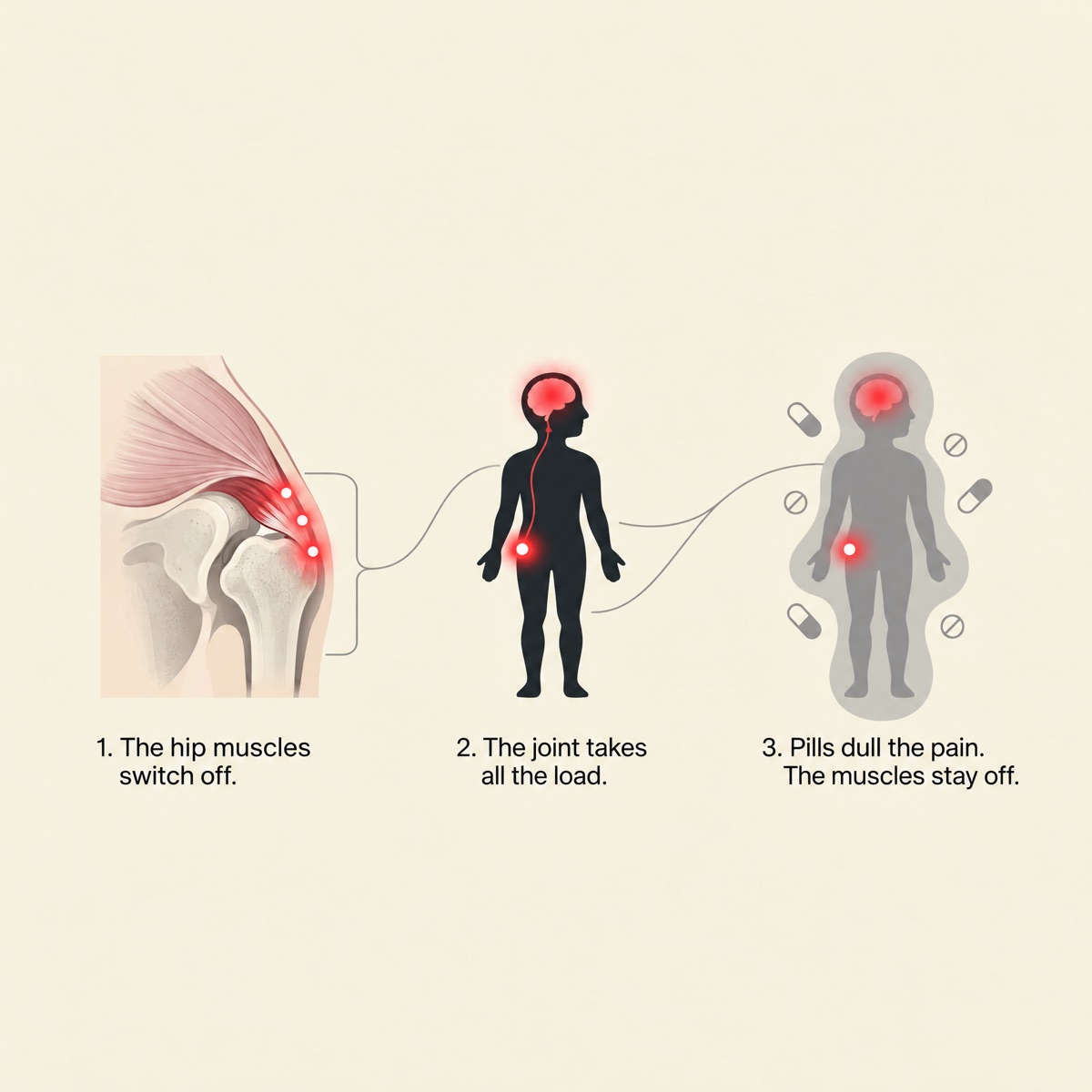
It is like painting over a crack in the wall, and never once looking at the foundation.
What Finally Reaches the Real Problem
Which raised the obvious question.
If the stabilizers are locked out — and if almost nothing on the shelf is aimed at them — then the real answer is not another pill or another shot.
The real answer is to make those muscles contract again, every day, without asking a painful joint to do the work — until the connection between brain and muscle rebuilds and they start firing on their own.
The catch is in that word: working. A muscle that has been switched off doesn’t answer an exercise sheet. It needs to be made to contract first.
That is exactly what neuromuscular electrical stimulation (NMES) does. It sends a gentle signal through the skin that makes the muscle itself contract. It has been used for decades in muscle rehabilitation and sports medicine.
The problem: for most women, it only ever existed in a clinic.
The Turning Point Came in 2026
That is finally changing.
In 2025, a small team of physical therapists and device engineers kept running into the same patient. A woman in her sixties, hip arthritis, years of pills and shots behind her — and outer hip muscles that simply would not switch on, no matter how many clamshells she did at home.
The research had identified the muscles. The technology to make them contract already existed. Every piece was there.
And no one had put it together. Millions of women with hip arthritis, a documented lockout in the muscles around the joint, and not one device made for them — because the stimulators on the market were built for backs, for knees, for athletes in a clinic, with wires everywhere and an app to pair. Nothing was made for a woman who wanted to sit in her own chair, put one pad on the outside of her hip, and press one button.
So rather than wait for someone else, they decided to build it.

They spent the better part of a year on it — the shape of the pad, so it sits right over the stabilizer on the outer hip; the work-and-rest rhythm of the stimulation; a remote with buttons big enough to press without reading glasses.
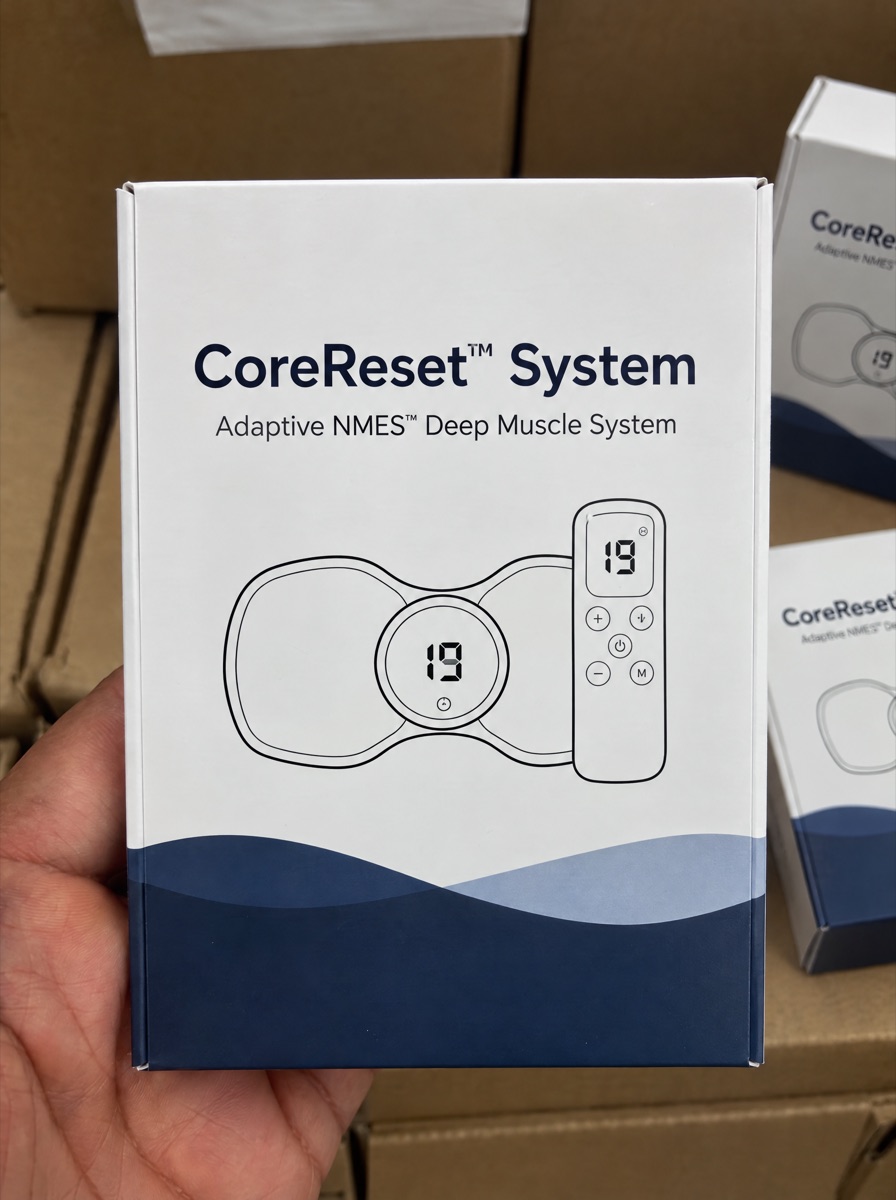
What came out of it is called CoreReset: an NMES device made specifically for the stabilizers on the outside of the hip.
The first units went to a group of women who had already tried everything on the shelf, and their progress was tracked over 90 days.
By day 90, the answers that came back changed how the team understood the lockout itself.
The Real-World Results
The first group was chosen deliberately: 1,084 women with hip arthritis, every one at least two years past diagnosis, every one having already worked through pills, cortisone and physical therapy — and every one told, at some point, that a replacement was “just a matter of time.” Before the hip, every one of them had been some version of the same woman: the one who gardened all Saturday, walked the dog twice a day, chased the grandkids around the park, and never once thought about getting up from a chair. Over the first 90 days, they reported the following.
Every response came from a real woman filling out a form on her phone, in her own words, on her own time. Individual results vary. CoreReset does not rebuild cartilage.

Inside CoreReset
Every part of CoreReset was designed around one job: making the hip stabilizers contract again, at home, without help.
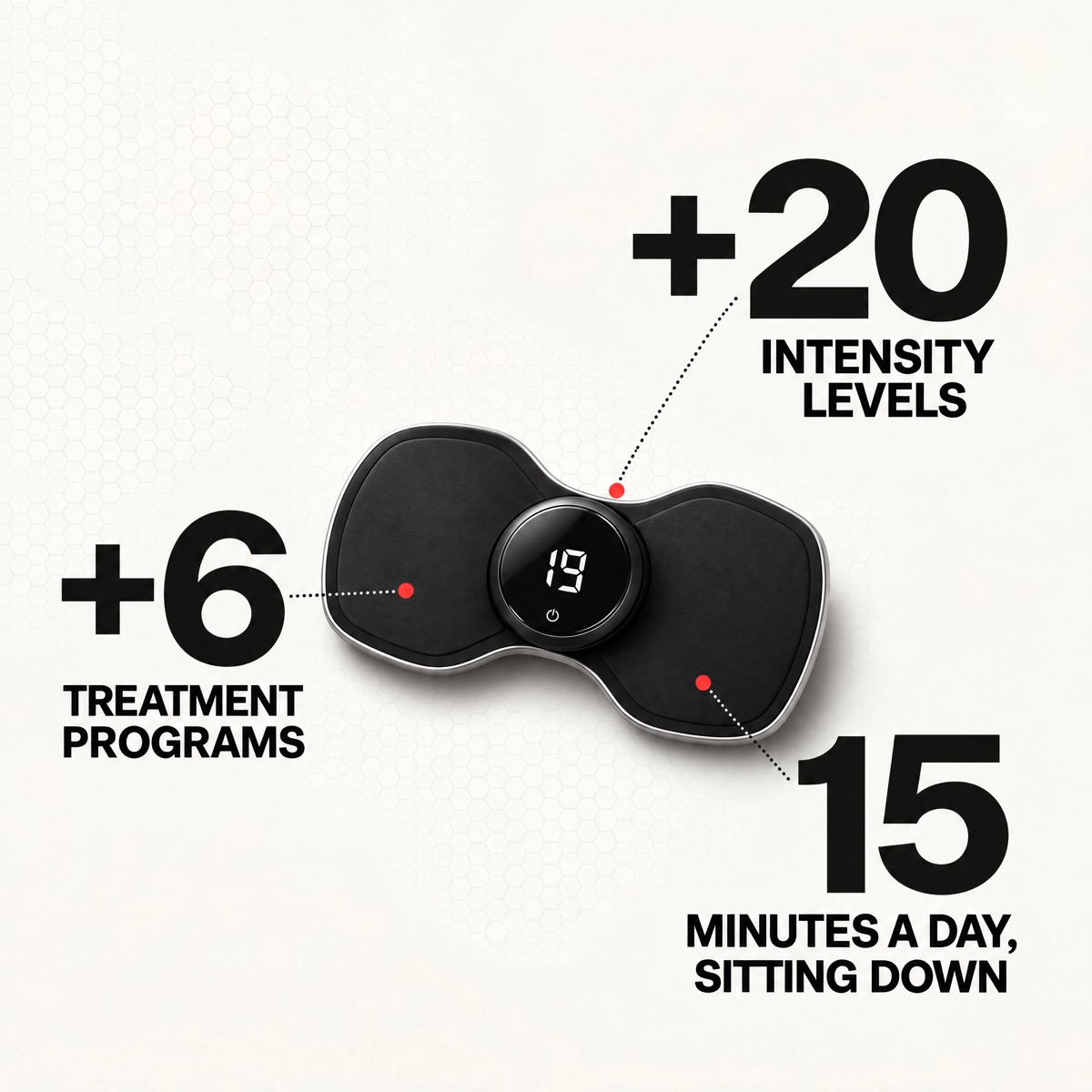
The muscles that were locked out get worked every day — so the hip isn’t carrying the load on its own anymore.
Works alongside what you already do.
CoreReset doesn’t replace your pills, your physical therapy or your doctor’s advice — it works on the muscles those treatments were never aimed at. Most women simply add one session a day to their routine.
Most routines for hip arthritis ask you to do more. CoreReset asks for fifteen minutes in your chair.
Do not use CoreReset if you have a pacemaker, defibrillator or other implanted device, if you are pregnant, if you have epilepsy, or on broken or numb skin. If you have a heart condition, recent surgery, or are being treated for your hip, talk to your doctor first.
If a device is aimed at the muscles nothing else has reached, standing behind it should not be complicated.
Use CoreReset for 90 days. If you don’t feel the difference, you get a full refund — and you can keep the device. Refunds are handled by our US support team within 48 hours.
The 90 days mirror the window the first group was tracked over — the same window in which most of them noticed a real change.
Every device also comes with a 1-year warranty.
Why Starting Sooner Matters
The lockout runs in one direction.
Every month the stabilizers stay quiet, they shrink a little more. Every bit of shrinking puts more load on the joint. More load means more pain. More pain switches the muscles down further. Which means even less support on the next step.
That is what sits behind what so many women describe as “it just keeps getting worse” — the walk to the mailbox that used to be nothing, the trip to the store that now needs a plan, the cane you’ve started eyeing and hate the thought of.
And it is why “wait until it’s bad enough” so rarely works out the way it sounds. Waiting doesn’t keep the hip where it is. Every month of waiting is another month of the muscles going quiet — and a weaker hip to carry into whatever comes next.
The muscles you have today are the most responsive they will be. Every month they go unworked, that changes.

Important — Please Read
CoreReset Is Not Sold on Amazon
CoreReset is only available at trykaviera.com. If it shows up anywhere else, it isn’t the real thing. Here’s what’s going on:
- Copycat “hip stimulators” have appeared on Amazon using the CoreReset name and photos.
- These knock-offs don’t have the Dual-Action program or the butterfly pad made for the outer hip.
- Some are never shipped at all — buyers are charged and receive nothing.
- Unfortunately, real customers have already been caught out this way.
- Kaviera is actively working to get these listings removed.
The genuine CoreReset is sold in one place only: trykaviera.com
From Women Who Had Stopped Expecting Anything to Help

The ache on the outside of the hip was the part nobody could explain, and this is the first thing that has ever touched it. About five weeks in I noticed I could stand at the stove long enough to actually cook dinner. I’m not going to say I’m cured, but I’m doing things I had stopped doing.

I use it every evening in my recliner while I watch TV. After about two months I realized I’d slept through the night on my bad side and hadn’t even noticed. Still have stiff mornings, but the nights are mine again.

Someone in a hip arthritis group shared the article and the part about the muscles switching off made more sense than anything I’d been told. Took about six weeks. Last Saturday I walked the whole grocery store without leaning on the cart. My husband noticed I wasn’t limping before I did.
Why it’s not always in stock
The last thing worth knowing is that CoreReset is not always in stock.
It is produced in small batches, and a portion of every batch goes to women already on their daily routine who reorder pads. Whatever remains is released to new customers, first-come, first-served.
When a batch sells out, the next one takes six to eight weeks to arrive, and existing customers are placed ahead of new customers for restocks.
But if CoreReset is in stock, this is an invitation to join the women who are already using it.