Your physical therapist was right about the muscle. Researchers now know why the exercises still didn’t work — and the order that finally does.





If you’ve been living with gluteal tendinopathy for more than six months — doing your exercises religiously, getting the shots, maybe the shockwave — and you’re still not meaningfully better, let me say what nobody has said to you: it’s not your fault.
You didn’t do the exercises wrong. You didn’t give up too soon. And it’s not “just your age.”
For years it was explained with one word: bursitis. “Just bursitis.” “Take an anti-inflammatory.” “Let’s do another shot.” Then an MRI or an ultrasound gave it a new name — gluteal tendinopathy — and a sheet of exercises. The name changed. The result didn’t.
That never explained why the shot wears off a little faster each time. Why the exercises made so many women sorer, not stronger. Why two women with the same diagnosis live completely different lives — one walks the dog every morning, the other dreads turning onto her side in bed. Something else has to be going on.
Researchers have been looking at that “something else” for over a decade.
And what they found is not a tendon that wore out. It is the muscle above the tendon — switched off. Here is how it happens, in the order it actually happens.

Step 1: Where It Really Starts
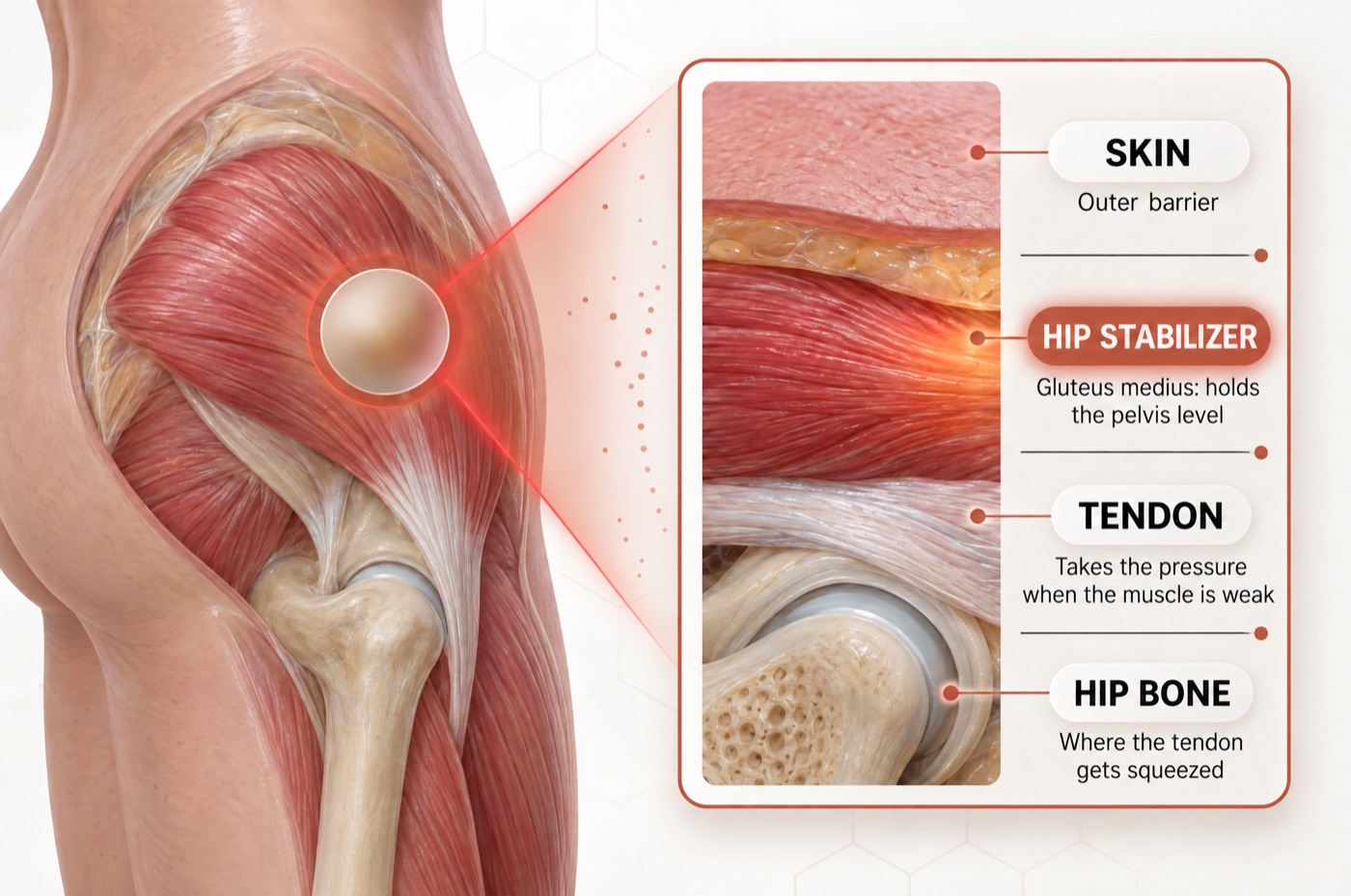
On the outside of your hip sits a fan-shaped muscle called the gluteus medius. Every time one foot leaves the ground, it fires on the other side and holds your pelvis level. Thousands of times a day. On every step, every stair, every time you stand up. In a healthy body, nobody ever thinks about it.
Three things wear it down, quietly, over years:
Decades of sitting. A muscle that holds you up only when you stand gets less and less practice. Desk, car, couch — the body slowly stops calling on it.
A woman’s wider pelvis. The wider the pelvis, the harder this muscle has to work to keep it level on every step. Women ask more of it than men do, with every single stride.
Falling estrogen. Around menopause, as estrogen drops, muscle starts losing strength a little every year — and the first to go are the muscles that carry the most weight for their size. This one holds up the whole pelvis on one leg, and nothing in normal life ever trains it. It weakens first, and it weakens with no pain at all.
Read that again: even the hip that doesn’t hurt is weaker. The weakness came first. The pain came after.
Step 2: The Tendon Gets Squeezed
When the gluteus medius can’t hold the pelvis level, your pelvis drops a little on every step and your thigh swings inward. The tendon underneath gets pressed against the bony point of the hip. Thousands of steps a day. Thousands of squeezes.
The tendon thickens and frays. That is what the MRI or ultrasound shows. That is the word on the report. And that is where the burning begins — on the outside of the hip, down the side of the thigh, worst at night on that side.
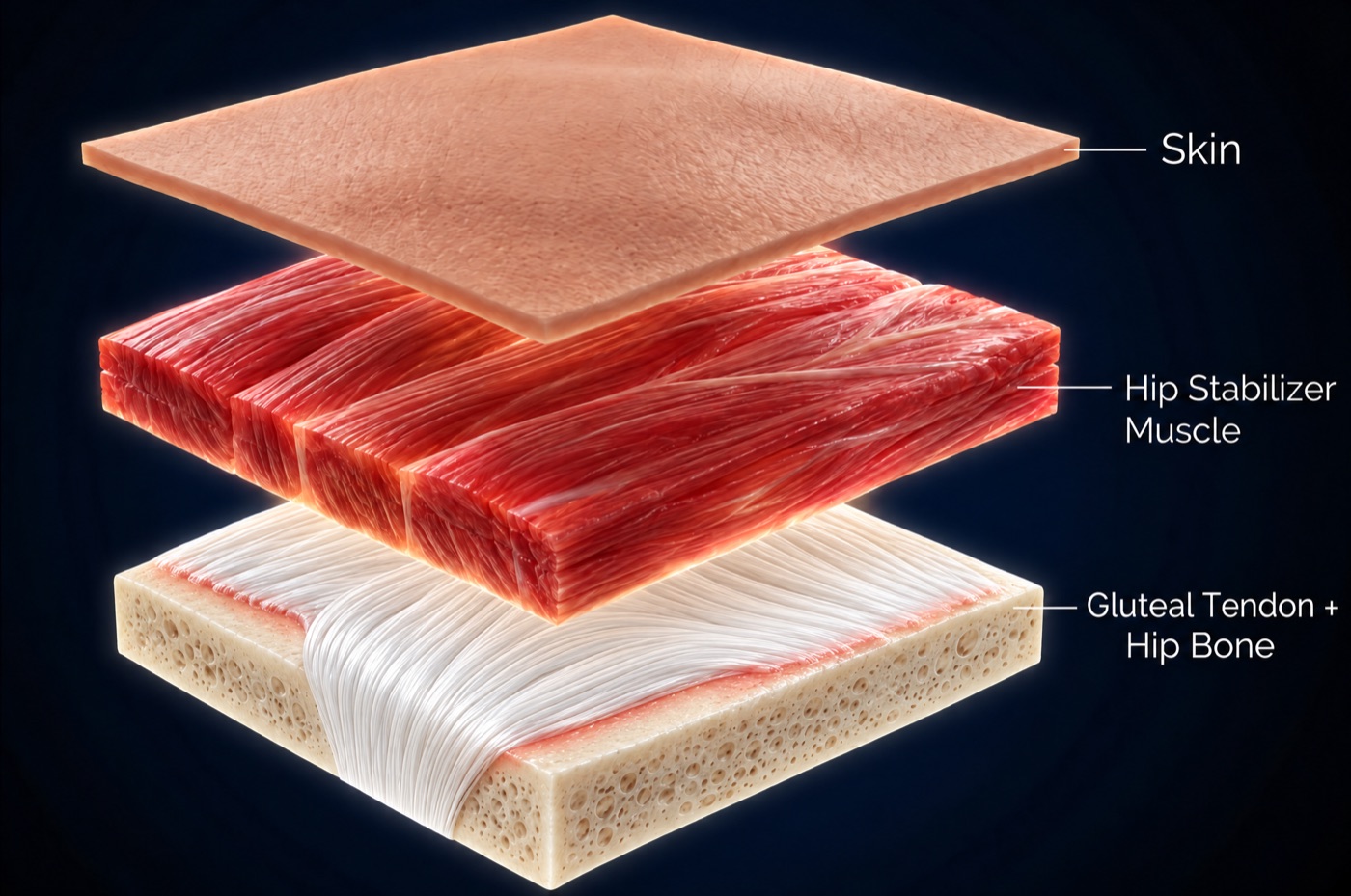
Almost every treatment you’ve been offered starts and ends right here, on the tendon. But the tendon is the victim, not the cause.
Step 3: The Muscle Gets Locked Out
This is the part nobody explains.
When the outer hip hurts, your nervous system does something you never asked it to do: it turns the gluteus medius down. On purpose. A protective reflex, to guard the sore spot. Think of a circuit breaker that trips to protect the house — except this one doesn’t reset on its own.
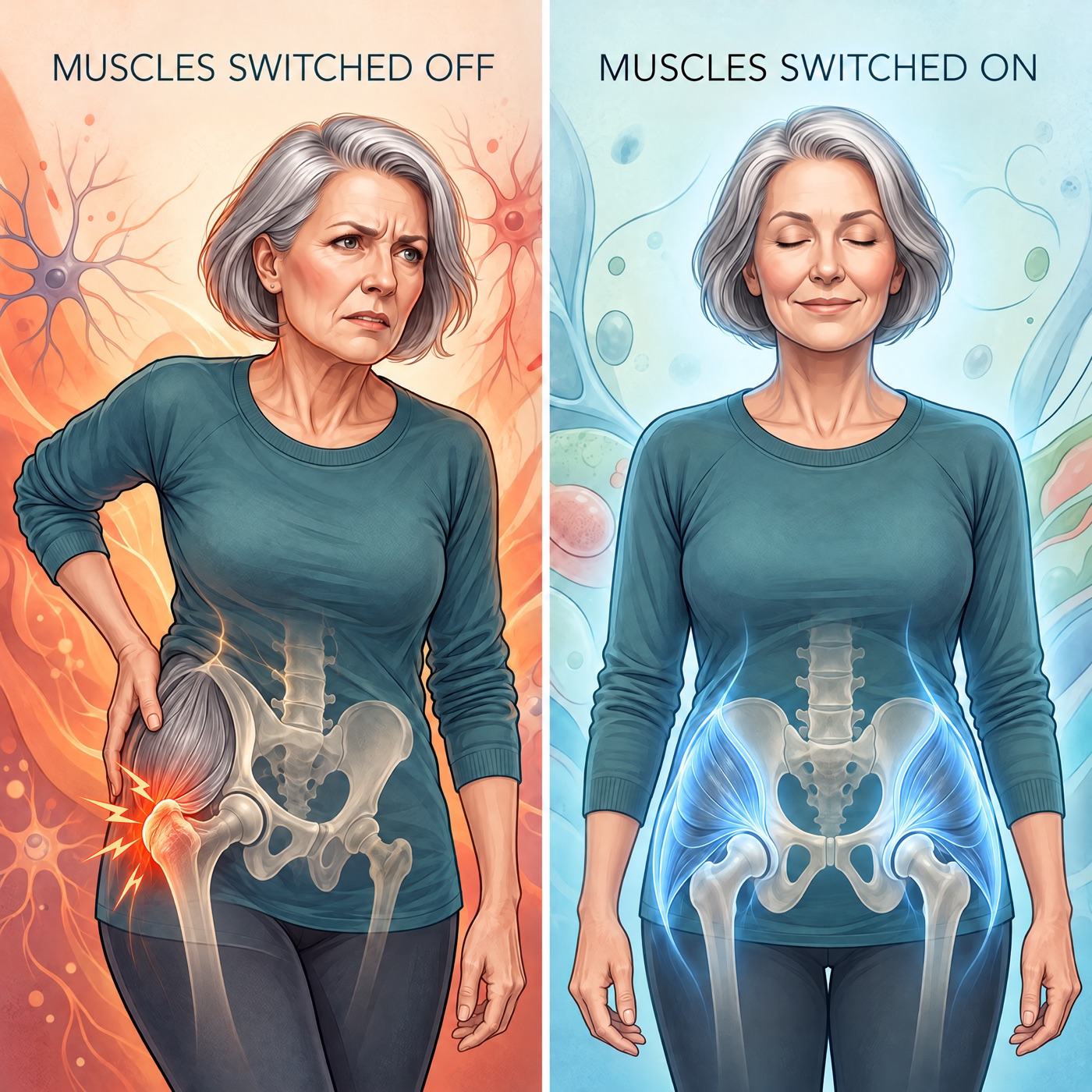
And a muscle that doesn’t fire doesn’t stay the same. It shrinks, and it fills with fat. It’s printed on the MRI report, right under the word everyone reads — and almost nobody looks at it.
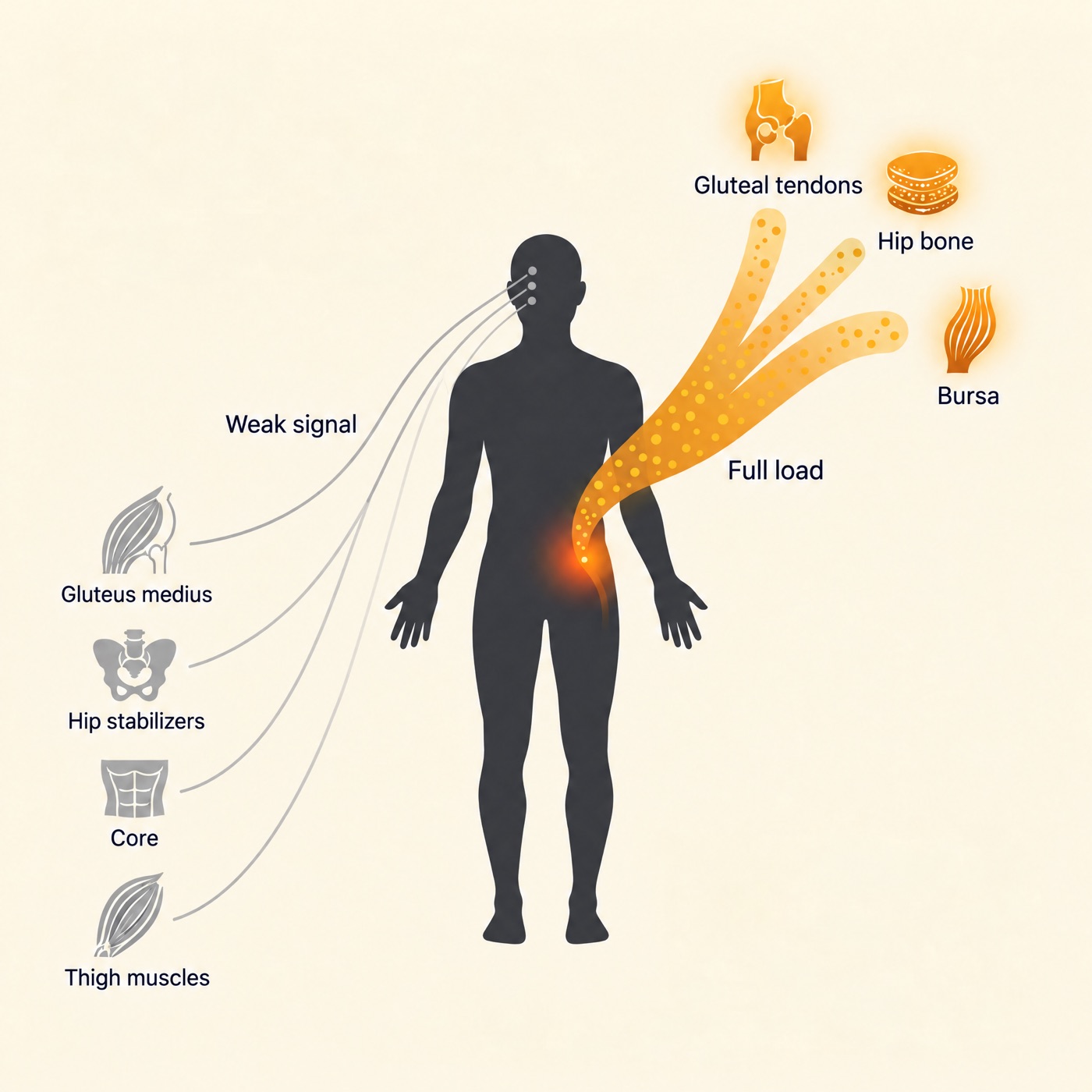
And that is where the circle closes.
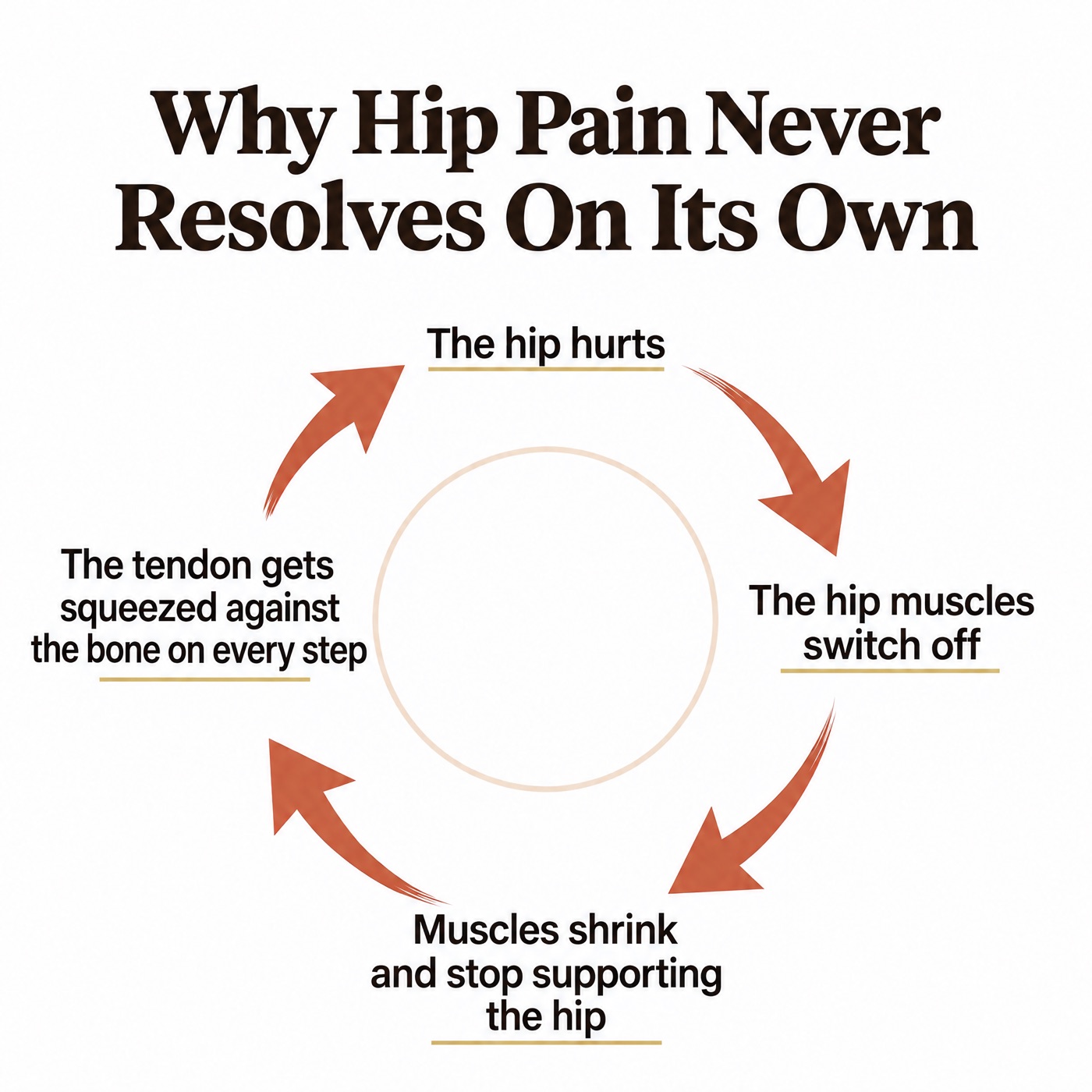
The hip hurts, so the muscle switches off. The muscle switches off, so the tendon takes more load. The tendon takes more load, so it hurts more. Month by month, the muscle that should be protecting you goes quiet.
Researchers call it muscle inhibition. I call it the Hip Muscle Lockout. Menopause lit the match. The lockout keeps the fire burning. The muscle isn’t gone — it’s locked out: still there, still able to work, but no longer answering on its own.
Why Every Symptom Finally Makes Sense
Once the lockout is understood, every symptom of gluteal tendinopathy — the ones that seemed random, the ones you were told are just bursitis — starts to fit together. Not as a list of unrelated problems. As one problem, showing up in a dozen places.
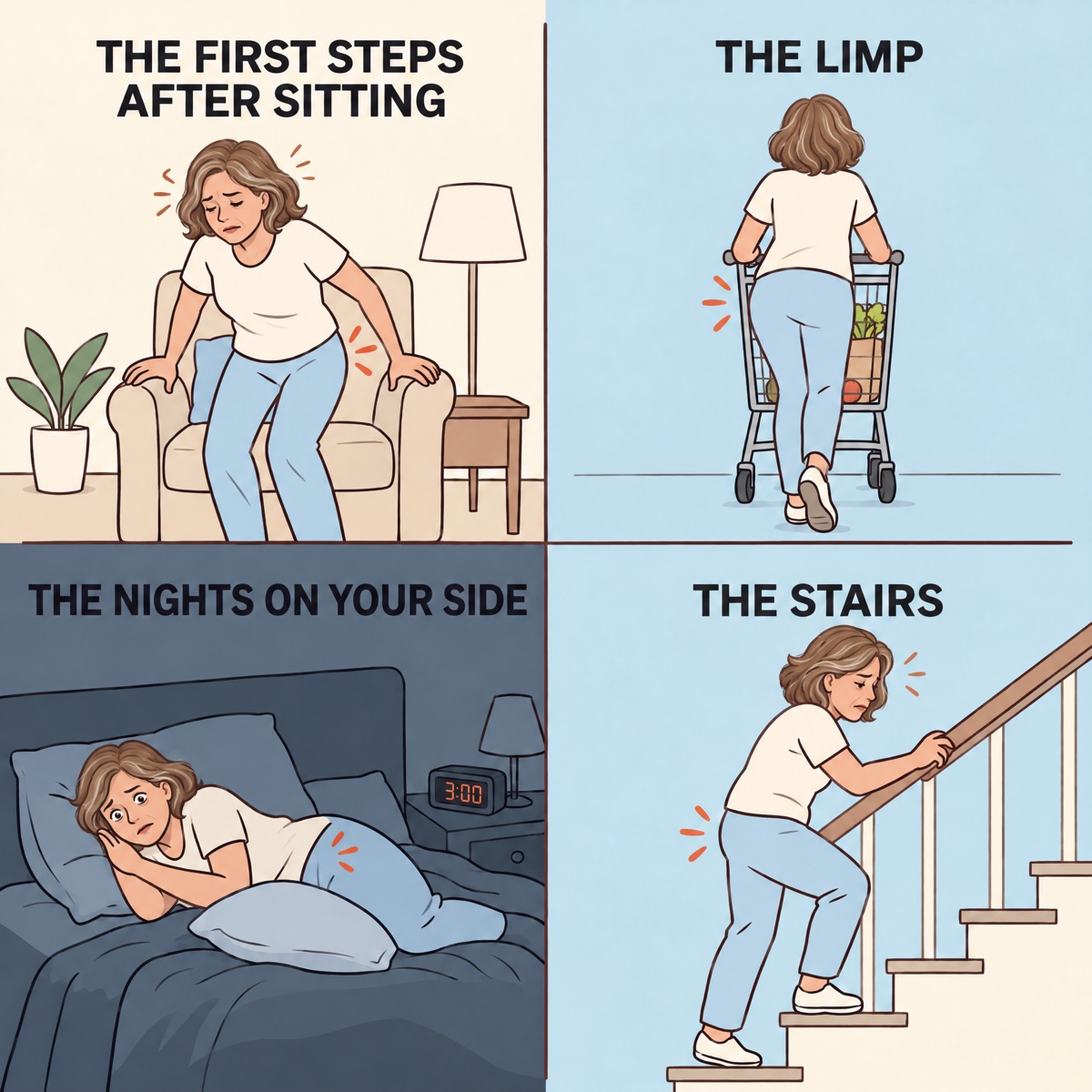
Sitting low or crossing your legs bends the tendon tight over the bony point of the hip. When you stand, the stabilizer is supposed to switch on before you even move. In a locked-out hip, it switches on late — or barely at all. So the tendon takes the strain alone.
The gluteus medius keeps the pelvis level on every step. When it stops firing, the pelvis drops and the hip swings out to the side — and that swing presses the tendon even harder against the bone, step after step.
Lying on your side presses the bony point of the hip into the mattress — right where the tendons of the quiet muscle attach. Lying on the other side, the top leg drops and stretches the same tendons tight.
Every stair — every leg into your pants — is a moment on one leg. With the stabilizer locked out, the tendon carries the whole body on its own — and the back and knee start paying for it too.
Step 4: Why the Exercises Made It Worse
Let me be fair to your physical therapist, because I am one. They were right about the muscle. The gluteus medius is the key, and strengthening it is one of the few things the research supports.
So why did it fail for you? Because of the order.
A strengthening program asks the muscle to work. A locked-out muscle can’t hear the command. So when you lie on your side and do a clamshell, a smaller muscle at the front of the hip does the work instead — and pulls the IT band tight across the bone like a strap. Every rep you did “for” the muscle squeezed the tendon instead.
It’s like pressing harder on the gas with the handbrake still on. The engine roars, the car barely moves, and something starts to burn.
It was the right program, in the wrong order.
You weren’t lazy. You did every rep. You were asked to build strength in a muscle that hadn’t been switched back on yet.
Why Nothing on the Standard Shelf Has Ever Lasted
Most women who have had gluteal tendinopathy for any length of time have cycled through the rest of the shelf.
Advil, morning and night. Voltaren gel. The cortisone shot — then the second, then the third, until the doctor says no more. Shockwave. A menopause supplement, collagen powder, a red light wrap. And the PRP quote, two thousand dollars, “not covered by insurance.”
And every one comes with the same pattern. A few good weeks. Then it wears off, and back to where things started.
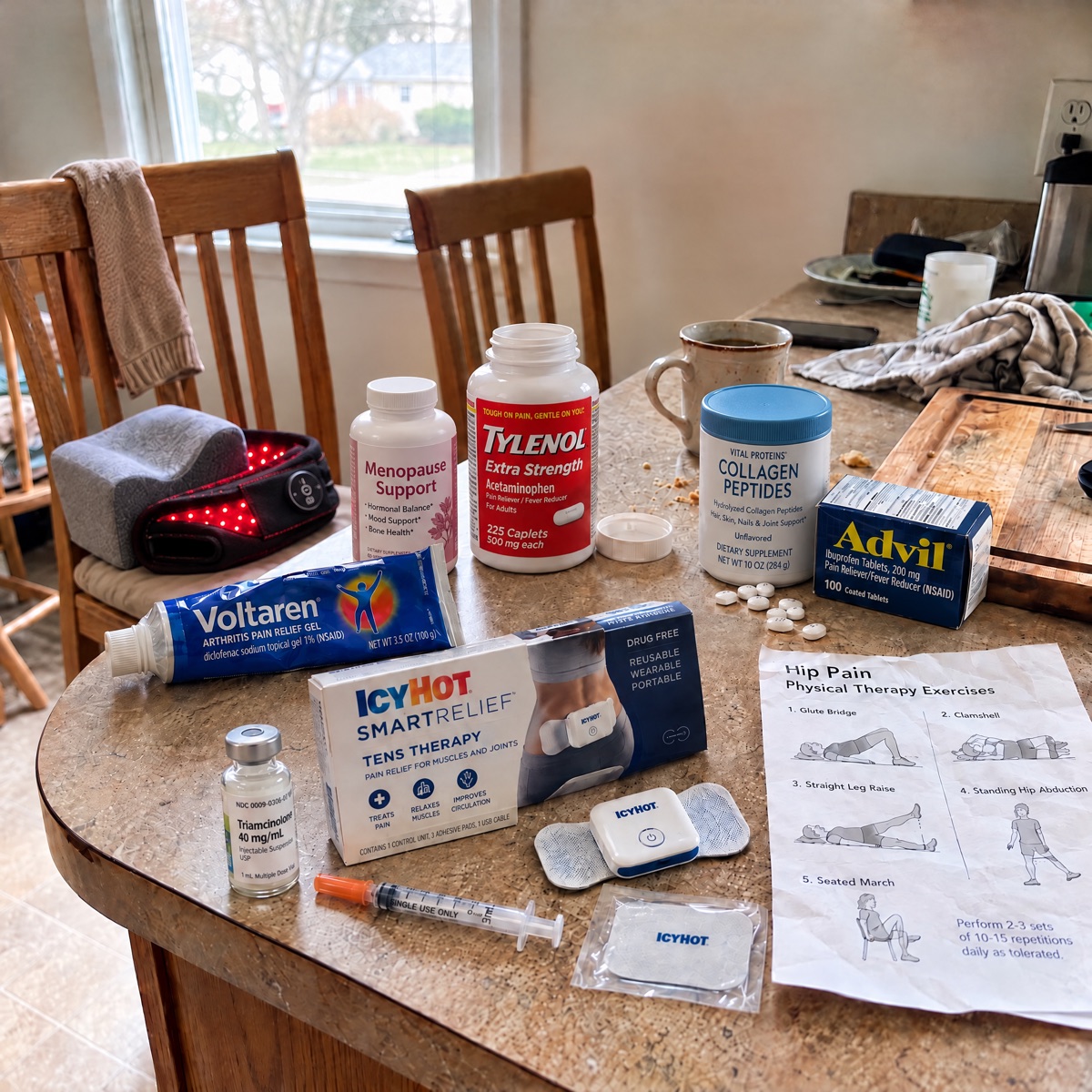
The reason is simple: every one of them works on the pain or on the tendon. Pills and gels dull the signal. The shot calms the tendon for a few weeks. PRP and shockwave are aimed at the tendon. The supplements and the red light feed the tendon or warm the skin. None of them switches the muscle back on.
And the system is built that way. The visit bills. The shot bills. The imaging bills. A fifteen-minute routine at your kitchen table has no billing code — so it is almost never offered.
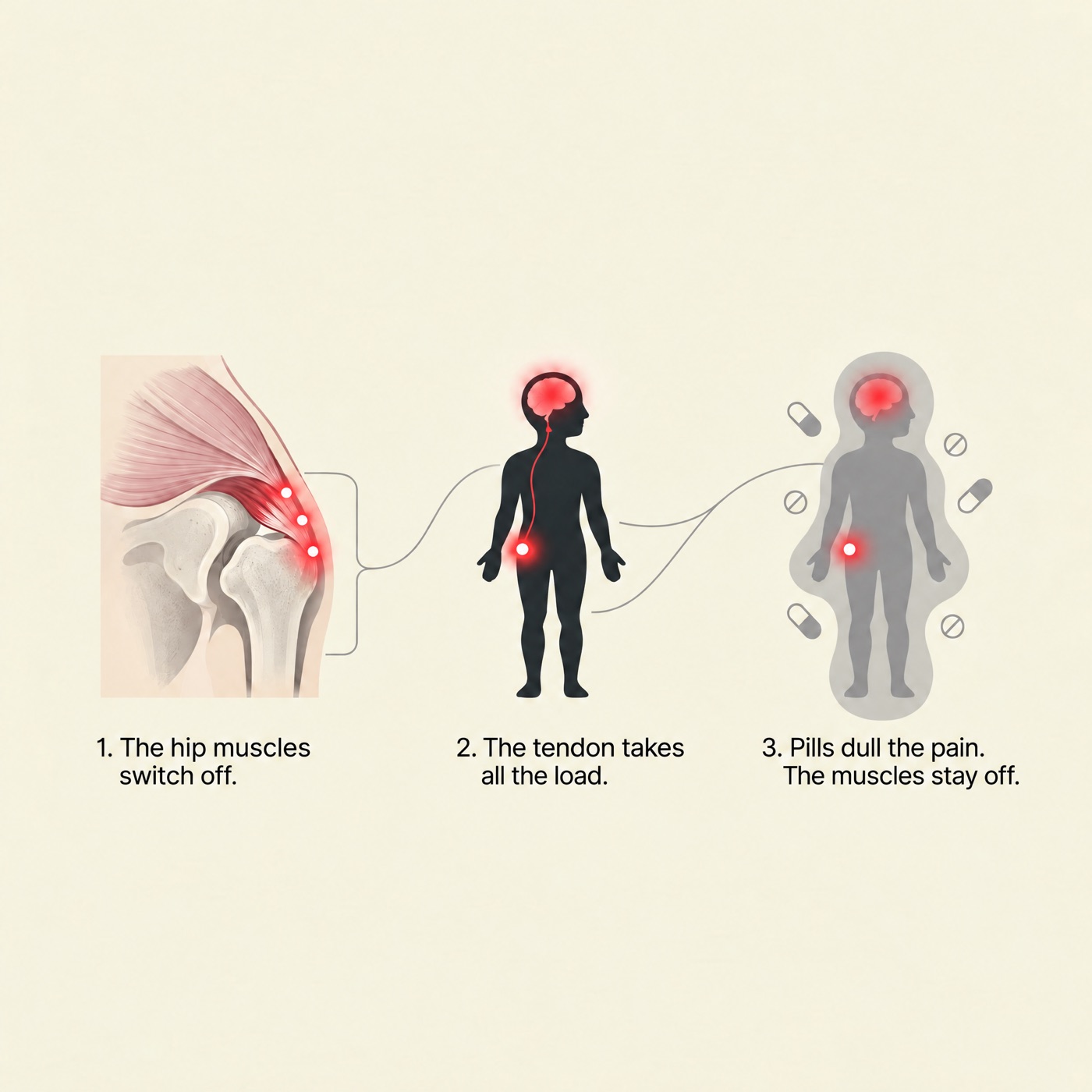
It is like painting over a crack in the wall, and never once looking at the foundation.
Step 5: Reverse the Order
If the muscle is locked out, the answer isn’t another shot. And it isn’t more reps on a muscle that can’t hear you.
The answer is to switch the muscle back on first — at zero load, without squeezing the tendon — and only then let it get strong.
That is exactly what neuromuscular electrical stimulation (NMES) does. It sends a signal deep into the muscle and makes it contract on its own — around the brain’s breaker. No movement. No weight on the hip. The tendon stays quiet while the muscle works.
And because the muscle contracts again and again, session after session, it doesn’t just wake up — it gets stronger. The brain-to-muscle connection rebuilds, and the gluteus medius starts showing up on its own, with every step. If you still want your exercises afterwards, now they can finally stick.
For decades, it only existed in rehab clinics — ten minutes, twice a week, which is never enough.
Before You Reach for Something You Already Have
“I’ll find the exercises on YouTube.” The videos show the right exercises — for a muscle that’s switched on. Yours isn’t. You can watch a thousand of them, do every rep, and the muscle still won’t hear the command.
“I already have a TENS unit.” A TENS buzzes the skin, five to eight millimeters deep, to mask the pain signal. The deep stabilizers of the hip sit thirty to fifty millimeters down. A TENS never reaches them. It never could.
“I’ll buy a cheap muscle stimulator.” Most are built for big, flat muscles near the surface — abs, backs, thighs. The gluteus medius is small, deep and tucked on the side of the hip. It needs the right pad, in the right place, with the right work-and-rest rhythm.
The Turning Point Came in 2026
That is finally changing.
In 2025, a small team of physical therapists and device engineers kept running into the same patient. A woman in her late fifties, years of “bursitis” shots behind her — and an outer hip muscle that simply would not switch on, no matter how many clamshells she did at home. The clamshells only made it worse.
The research had identified the muscle. The technology to switch it back on already existed. Every piece was there. And no one had put it together for her — because the stimulators on the market were built for backs, for knees, for athletes in a clinic, with wires everywhere and an app to pair.
So rather than wait for someone else, they decided to build it.

They spent the better part of a year on it — the shape of the pad, so it sits right over the gluteus medius on the outer hip; the work-and-rest rhythm of the stimulation; a remote with buttons big enough to press without reading glasses.
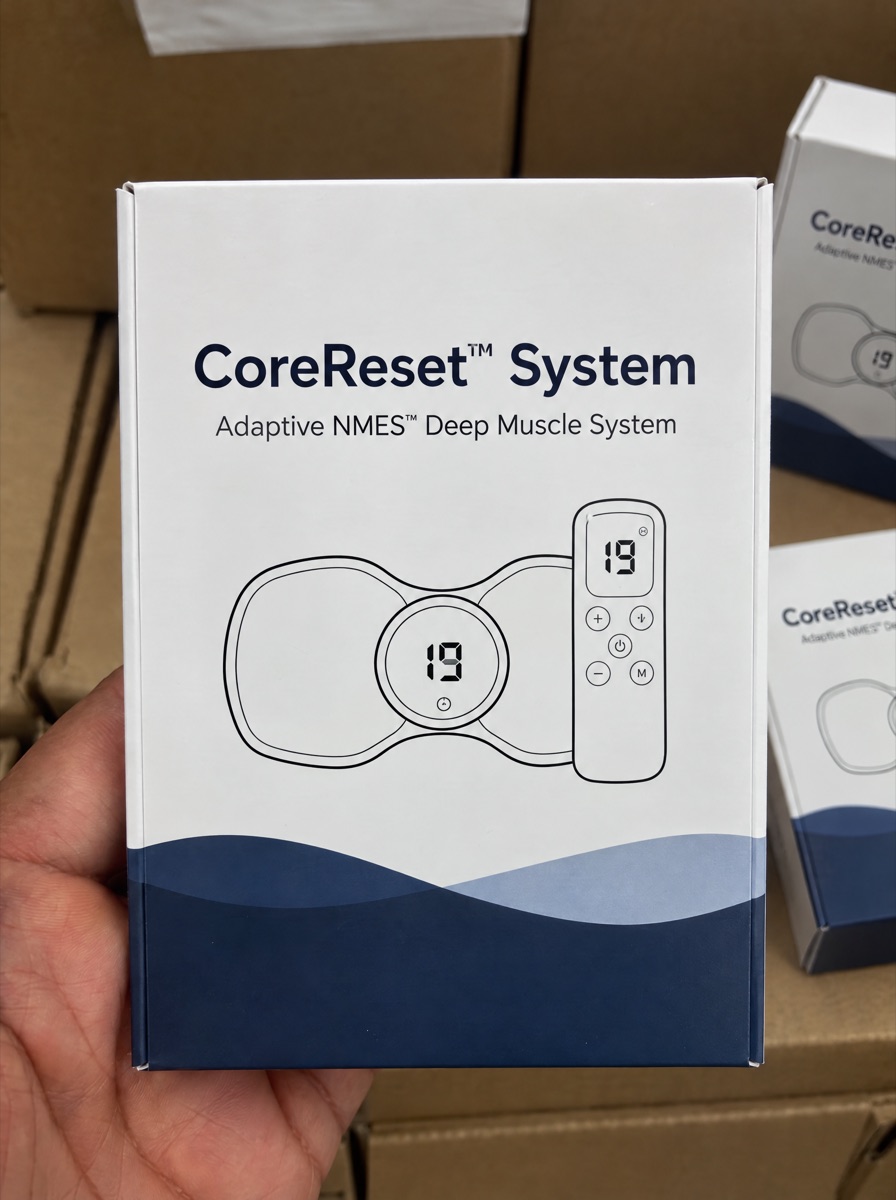
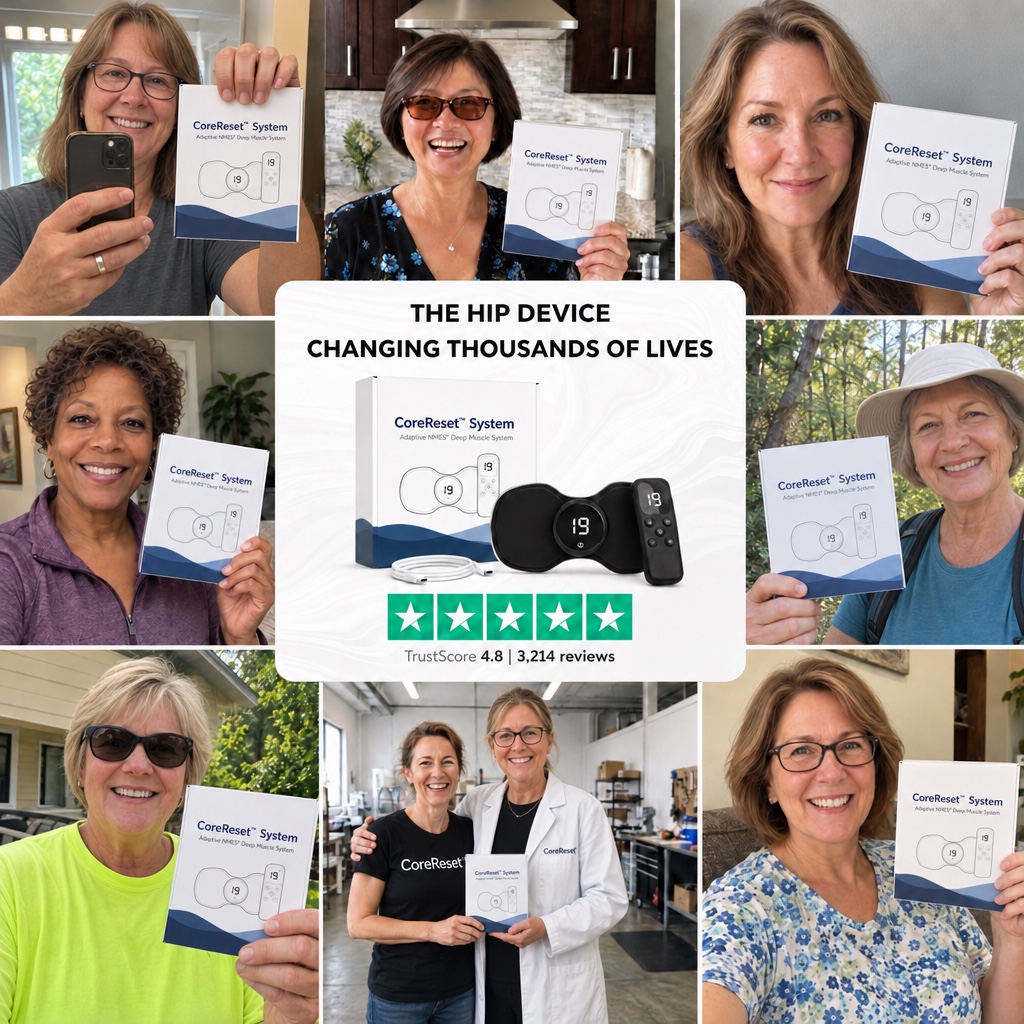
What came out of it is the CoreReset NMES Pro: a Dual-Action NMES device made specifically for the muscle on the outside of the hip. One phase switches the muscle back on without loading the tendon. The other rebuilds the connection, session after session.
The first units went to a group of women who had already tried everything on the shelf, and their progress was tracked over their first 60 days.
The Real-World Results
The first group was chosen deliberately: 1,084 women with gluteal tendinopathy, most of them first told it was bursitis, every one in pain for at least two years, every one having already worked through pills, cortisone shots and physical therapy. Over their first 60 days, they reported the following.
Every response came from a real woman filling out a form on her phone, in her own words, on her own time. Individual results vary. CoreReset does not repair a torn tendon.
What to Expect in Your First 60 Days
Day one: a deep, slow pulse inside the muscle — not a buzz on the skin. By the end of the session, the side of your hip feels lighter, as if something finally let go. Many women sleep a little easier that same night.
Week one: you wake up less. The pillow between your knees stays where you put it. Getting out of bed takes one move instead of three.
Weeks two to three: you roll onto your bad side without the spike that used to wake you — and fall asleep there.
Weeks four to six: you stand up from the car without negotiating. The stairs stop being a strategy. The walks come back.
Day 60: the muscle holds your pelvis on its own. Most women no longer need it every day — it stays on the nightstand for when the hip starts to talk again. It’s yours: no refills, no appointments, no next shot.
Inside the CoreReset NMES Pro
Every part was designed around one job: switching the hip muscle back on, at home, without help — and without pressing on the tendon.
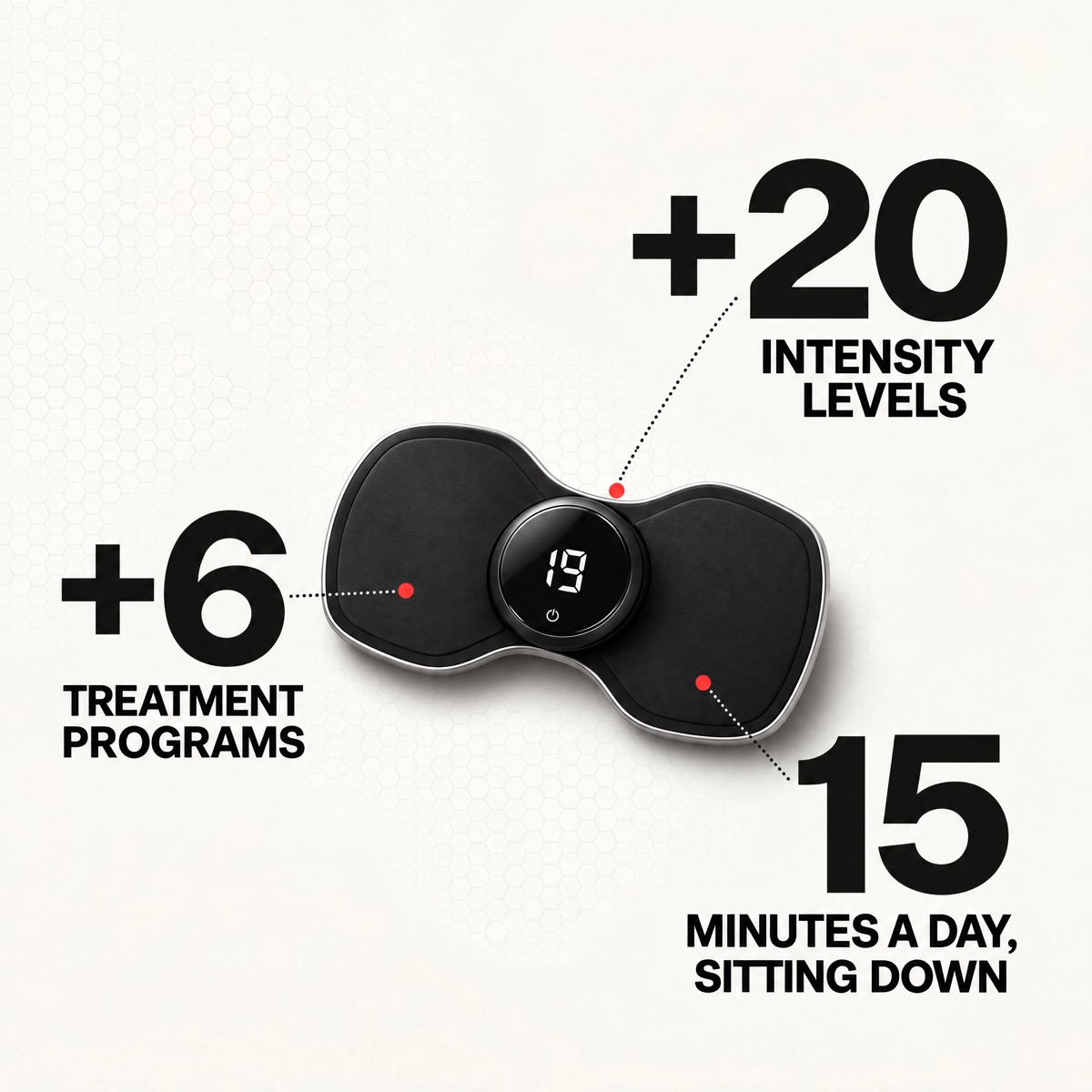
The muscle that was locked out gets worked every day — so the tendon isn’t carrying the load on its own anymore.
Works alongside what you already do.
CoreReset doesn’t replace your physical therapist or your doctor’s advice — it switches on the muscle they were trying to reach. Most women simply add one session a day to their routine.
Do not use CoreReset if you have a pacemaker, defibrillator or other implanted device, if you are pregnant, if you have epilepsy, or on broken or numb skin. If you have a heart condition, recent surgery, a torn tendon, or are being treated for your hip, talk to your doctor first.
If a device is aimed at the muscle nothing else has reached, standing behind it should not be complicated.
Most women need about 60 days to feel the lockout break. Your CoreReset is covered by our 90-day money-back guarantee — more time than you need to feel it for yourself.
Every device also comes with a 1-year warranty.
Why Starting Sooner Matters
The lockout runs in one direction.
Every month the muscle stays quiet, it shrinks a little more. Every bit of shrinking puts more load on the tendon. More load means more pain. More pain switches the muscle down further. Which means even less support on the next step.
That is what sits behind what so many women describe as “it just keeps getting worse” — until a new word shows up on the MRI report: tear.
The muscle you have today is the most responsive it will be. Every month it stays locked out, that changes.

Important — Please Read
CoreReset Is Not Sold on Amazon
CoreReset is only available at trykaviera.com. If it shows up anywhere else, it isn’t the real thing. Here’s what’s going on:
- Copycat “hip stimulators” have appeared on Amazon using the CoreReset name and photos.
- These knock-offs don’t have the Dual-Action program or the butterfly pad made for the outer hip.
- Some are never shipped at all — buyers are charged and receive nothing.
- Kaviera is actively working to get these listings removed.
The genuine CoreReset is sold in one place only: trykaviera.com
From Women Who Had Stopped Expecting Anything to Help

This is the first thing that has ever touched the burning on the side of my hip. About five weeks in I noticed I could sit through a whole movie without shifting. I’m not going to say I’m cured, but I’m doing things I had stopped doing.

I use it every evening in my recliner while I watch TV. About three weeks in I realized I’d slept through the night on my bad side and hadn’t even noticed. Still have stiff afternoons, but the nights are mine again.

The part about the muscle being switched off made more sense than anything I’d been told. No movement, nothing to push through. Took about six weeks. Last Saturday I walked the whole farmers market. My husband noticed I wasn’t limping before I did.
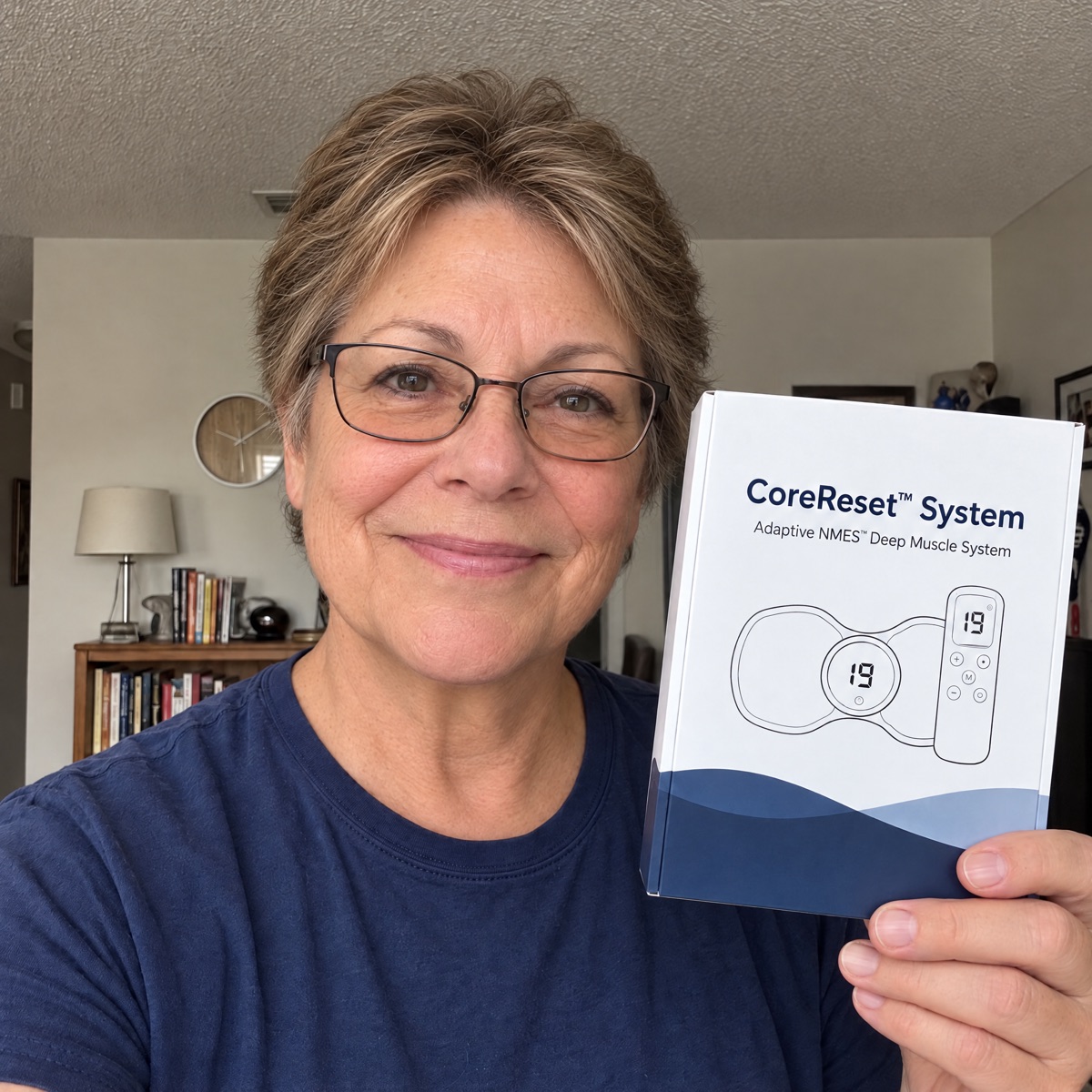
Why it’s not always in stock
The last thing worth knowing is that CoreReset is not always in stock.
It is produced in small batches, and a portion of every batch goes to women already on their daily routine who reorder pads. Whatever remains is released to new customers, first-come, first-served.
When a batch sells out, the next one takes six to eight weeks to arrive, and existing customers are placed ahead of new customers for restocks.
But if CoreReset is in stock — and today it’s up to 64% off — this is an invitation to join the women who are already using it.