Orthopedic Specialist Warns: I've Treated Thousands of Women Told They Have Hip Bursitis, and the Bursa Was Never the Cause

What an orthopedic surgeon discovered when his own wife was handed the same diagnosis, and the 15 minute evening ritual that has already woken the Guardian for thousands of women.

The Real Reason Your Bursitis Treatments Keep Failing
If you've been managing hip bursitis for more than six months, doing the loading programs, the injections, the shockwave, and you're still not meaningfully better, I want to share something before your doctor recommends the next round.
The treatment you've been receiving may be targeting the wrong place entirely.
That place is not your bursa. It is a muscle two inches away that, in all probability, nobody has checked once.
I've spent 26 years in orthopedics, the last fifteen in hip and sports medicine, and I've sat across from thousands of women told their hip pain was bursitis, then tendinopathy, then "something to manage."
And for most of those years, when the treatments failed, I wrote one word on their chart.
Bursitis.
It sounds like an answer. It isn't. It's what we write when the outside of the hip hurts and we don't ask why. A big word that sounds like a solved mystery, handed over with a printout of clamshell exercises and a "see you in three months."
If no one has ever apologized for that, let me be the first. Because what I found when I finally started asking why changed how I practice, and it started in my own house.
The Night It Came Home

Twenty years into my career, my wife Carol, fifty-six at the time and still teaching full time, started describing the same symptoms I had been filing away on other women's charts for two decades.
Pain on the outside of the hip that pulsed at night. Mornings spent testing the floor before trusting it. One good side to sleep on, and a pillow clamped between her knees like medical equipment.
For three years, I watched her run the same gauntlet my patients ran. First the word bursitis, and a cortisone shot that bought her five good weeks. Then the new word, tendinopathy, and months of loading exercises she did religiously, in our living room, while I pretended not to see her wince. Then shockwave. A TENS unit that ended up in a drawer. A red light panel in the spare room. Collagen powders lined up on the kitchen counter like little jars of hope.
The woman who used to outwalk me started sleeping upright in the recliner, because the bed had become the enemy.
And I am ashamed to admit this part: for two of those years, I explained her pain the way I had been trained to. Her age. Her hormones. Wear and tear. I was the surgeon. And I was looking at the wrong thing.
The Clue Was Sitting in the Research All Along
The night I finally got angry about it, I did what I should have done years earlier. I pulled the research on lateral hip pain and read it as a husband, not a surgeon.
And there it was, in study after study, some of it going back decades: in women with this condition, the gluteus medius, the muscle that stabilizes the hip with every step, is measurably inhibited. Present, but not firing. The scans kept showing everyone the damaged tendon. The research kept whispering about the muscle behind it.
Even the landmark trial on this condition, the LEAP trial published in The BMJ, the one every specialist cites, said it out loud: a structured muscle approach left the cortisone injection far behind, roughly 8 out of 10 improved versus about half with the shot. We quoted the conclusion and kept injecting the tendon.
The answer was never hidden. We were just never looking where it pointed.
The Guardian That Switched Off

Here is the anatomy they never explain to you. Your gluteus medius is your hip's Guardian. Every time you stand on one leg, and you stand on one leg with every single step you take, it fires to keep your pelvis level and carry the load that would otherwise crush the tendons and the bursa beneath it.
Think of your tendons as the ropes of a suspension bridge, and this muscle as the tower holding them. When the tower stops carrying its share, the ropes don't complain right away. They fray. Slowly. For months.
And then, around menopause, something changes that no one warns you about. Estrogen is one of the signals that keeps muscle strong, and as it falls, muscle starts losing strength. The first to go are the muscles that carry the most weight for their size. Your Guardian holds up your entire pelvis every time you stand on one leg, and nothing in normal life ever trains it. So it weakens first. Silently. No pain at all.
But a Guardian that can't hold the pelvis level lets it drop a little with every step, and the tendon underneath gets pressed against the bone. Five thousand steps a day, five thousand squeezes. That is when the burning starts.
Notice when it hurts. Lying on your side. Crossing your legs. Standing on one leg to step into your pants. Every one of those positions presses the tendon against the bone. If your tendon were simply "old," it would hurt the same all the time. It hurts when it's being crushed.
And here is the cruel part. The moment that tendon hurts, your brain does what brains do to protect a painful joint: it turns the Guardian down even further, like a breaker tripping in a house. Researchers have a name for this reflex: arthrogenic muscle inhibition. When a joint hurts, the nervous system quietly cuts the signal to the muscles around it, to protect it. It was meant to last days. In women with this condition, it never switches back. The muscle is still there. It is simply not being turned on.
So the bursa gets squeezed, that was the first diagnosis. The tendons fray, that was the second. Two labels. One cause. A tower that stopped holding.
The Cycle That Keeps You Stuck

From there, the trap closes quietly. The hip hurts, so you move less. Moving less switches the Guardian down further. A weaker Guardian loads the tendon more. More load, more pain, less movement. Around and around, while the calendar pages fall.
You recognize the life this builds. Getting out of a chair becomes a small negotiation. The stairs become a strategy. You start saying no to things, the walk, the trip, the garden, in ways so gradual that nobody around you notices the shrinking.
And this is usually where someone sells you the hormone story: it's menopause, your tendons are losing collagen. That part is true, but not the way they tell it. The drop in estrogen didn't attack your tendon first. It quietly weakened the muscle that protects it. That was the match. What's burning now is something else.
A tendon doesn't break because it's fifty-five. A twenty-five-year-old's tendon would burn too if you pressed it into the bone five thousand times a day. You can feed it collagen. You can bathe it in red light. You can inject it. Tomorrow it gets crushed again.
And you don't put out a fire by taking back the match. You can't undo menopause, and you don't need to. Women on full hormone therapy get this pain too. Raising your estrogen today does not unlock a muscle your brain switched off years ago. The lock isn't hormonal. It's in the wiring between your brain and your Guardian.
Estrogen lit the match. The switched off Guardian is the fire. Millions of women go through menopause and never develop this pain, because their Guardian stayed on duty. And no capsule can switch a muscle back on. That is not a nutritional problem. It is an electrical one.
The hormones explain how it started. The switched off muscle explains why it never heals.
Why Nothing You Tried Ever Worked

Now look back at your own gauntlet through this lens, and watch every failure explain itself.
The loading program. Clamshells, bridges, band walks, done religiously while your friends just went for walks. It demands strength from a muscle your brain has switched off. You cannot train a muscle that isn't firing. You were handed a gym program for an electrical problem.
The cortisone injection. Three to six good weeks, just long enough to give you hope, because it calms the area while doing nothing about what crushes it every night.
The shockwave. Expensive, uncomfortable, and aimed at the victim. It asks a fraying tendon to remodel while the tower keeps leaning on it.
The TENS unit in your drawer. It distracts sensory nerves five to eight millimeters down. The Guardian sits thirty to fifty millimeters deep. It literally cannot reach it.
The red light panel. Let's be blunt about this one: for a muscle that has switched off, red light does absolutely nothing. Not a little. Nothing. Those photons fade out within the first few millimeters of tissue, the same shallow neighborhood as the TENS. They can warm skin and calm surface irritation. They cannot reach a muscle locked thirty to fifty millimeters down, and even if they could, light cannot make a muscle contract. Pretty glow. Wrong tool. Wrong depth. Wrong problem.
The collagen powders and hormone supplements. A capsule has to survive your stomach and your bloodstream, and maybe, months later, something reaches your hip. Even if it did: you cannot rebuild a tendon that is still being crushed every single night. Hope, swallowed daily.
Every one of these options works around the lockout. None of them works on it. You didn't fail the treatments. The treatments failed the mechanism.
It's Not a Tendon Problem. It's a Switch Problem.
Here is what took me twenty years too long to see, and what I now tell every woman who sits in my office.
Ask a hundred experts how to fix lateral hip pain and a hundred will hand you the same answer: exercises for the muscle. Not the tendon. Everyone in medicine already knows, deep down, that the tendon is simply what breaks when the muscle stops doing its job. The tendon is the consequence. The muscle is the cause. That is why every treatment plan ever written ends with a page of exercises.
Your physical therapist was right about the muscle. Wrong about the fix.
So the cure was never in doubt. The muscle must be retrained. The only question nobody could answer is how, because a muscle your brain has switched off cannot be trained with exercises. You cannot clamshell your way into a contraction that isn't happening.
Until you stop asking the muscle to fire, and start making it fire.
The Discovery That Changed Everything
The technology that breaks this cycle is not new, and it is not experimental. It has been used in rehabilitation clinics and by professional sports teams for over 40 years. It's called NMES: neuromuscular electrical stimulation.
Every treatment you tried asked the muscle to fire. NMES does the opposite. It sends targeted pulses deep into the tissue and makes the Guardian contract, bypassing the brain's off switch entirely. The muscle cannot say no. Contraction after contraction, the pathway between brain and muscle rebuilds itself, until the Guardian starts showing up on its own again.
5 to 8mm deep
The Guardian stays asleep.
30 to 50mm deep
Forces it to fire.
The deep stabilizers of your hip sit thirty to fifty millimeters below the skin. Surface stimulation stops at eight.
When I first watched it work on Carol's hip, after three years of watching everything else fail, I understood why clinics guard this tool so casually. It was never a secret. It was just never offered to women like her.
The Treatment Reserved for Clinics and Pro Athletes
There was, of course, a catch. Clinical NMES means appointments. A machine the size of a nightstand. Sessions billed one by one, weeks of them, assuming you can find a clinic that offers it for this condition at all. Professional athletes get it daily, between practices, as a matter of routine. A 56 year old woman with a hip that hurts at night gets a printout of clamshells.
I called colleagues. The answer was always the same: yes, it works, yes, we use it, no, there's no practical way to prescribe it for months of daily use at home.
Carol needed the clinic's technology without the clinic. That device did not exist on any shelf I could find. So I went looking for the people building it.
So We Brought the Clinic Into the Living Room
After months of searching and testing, I found a small engineering team working on exactly this: an at home NMES device, calibrated not for athletes' quads but for the deep stabilizers of the hip, the exact thirty to fifty millimeter depth where this lockout lives. It's called the CoreReset Adaptive Correction System™, and I put my name behind it only after Carol had used it for twelve straight weeks.
Every 15 minute session does two things:
Phase A: Load Offload. Gentle, rhythmic contractions rebuild the suspension around your hip, taking your body weight off the tendon so it can finally heal.
Phase B: Reeducation. Contraction after contraction, the pathway between your brain and the Guardian rebuilds itself. In about 30 days, the muscle starts firing on its own again, and now loading work, if you still want it, can actually stick.
Fifteen minutes a day. Six programs, twenty intensity levels. It switches itself off when the session is done. Most women run it while watching the evening news.
See If CoreReset Is Right For YouWhat Happened to My Wife

The first session, Carol felt something she hadn't felt in years: a deep, slow pulse inside the hip. Not the surface buzz of her old TENS. The muscle itself, contracting. Her word for it was "weirdly emotional."
By the end of week one, the pillow between her knees stayed in place all night instead of ending up on the floor. By week three, she stood up from the car without the little negotiation I had watched a thousand times. Around week six, she slept on her forbidden side and woke up without the flare. If you've lived with this condition, you know that sentence is everything.
At 90 days she dropped to maintenance, fifteen minutes on Monday, Wednesday, Friday. The Guardian carries her the rest of the week. Last spring she sent me a photo while I was at the clinic: crouched in her garden at golden hour, both hands in the tomato plants. Two years earlier she couldn't lie flat in her own bed.
The tendon got what it had needed all along: its bodyguard back.
What to Expect in Your First 90 Days

Week one: the deep pulse in the very first session, and by the end of the week, the pillow stays in place all night.
Weeks two to four: you stand up from the car without negotiating. The stairs stop being a strategy. You catch yourself walking to the mailbox just because you can.
Weeks five to eight: you sleep on your forbidden side and wake up without the flare.
Day 90: you drop to maintenance, fifteen minutes, three times a week. The Guardian does its job the rest of the week, quietly, the way it used to.
How Does It Actually Work? (It Takes 15 Minutes)
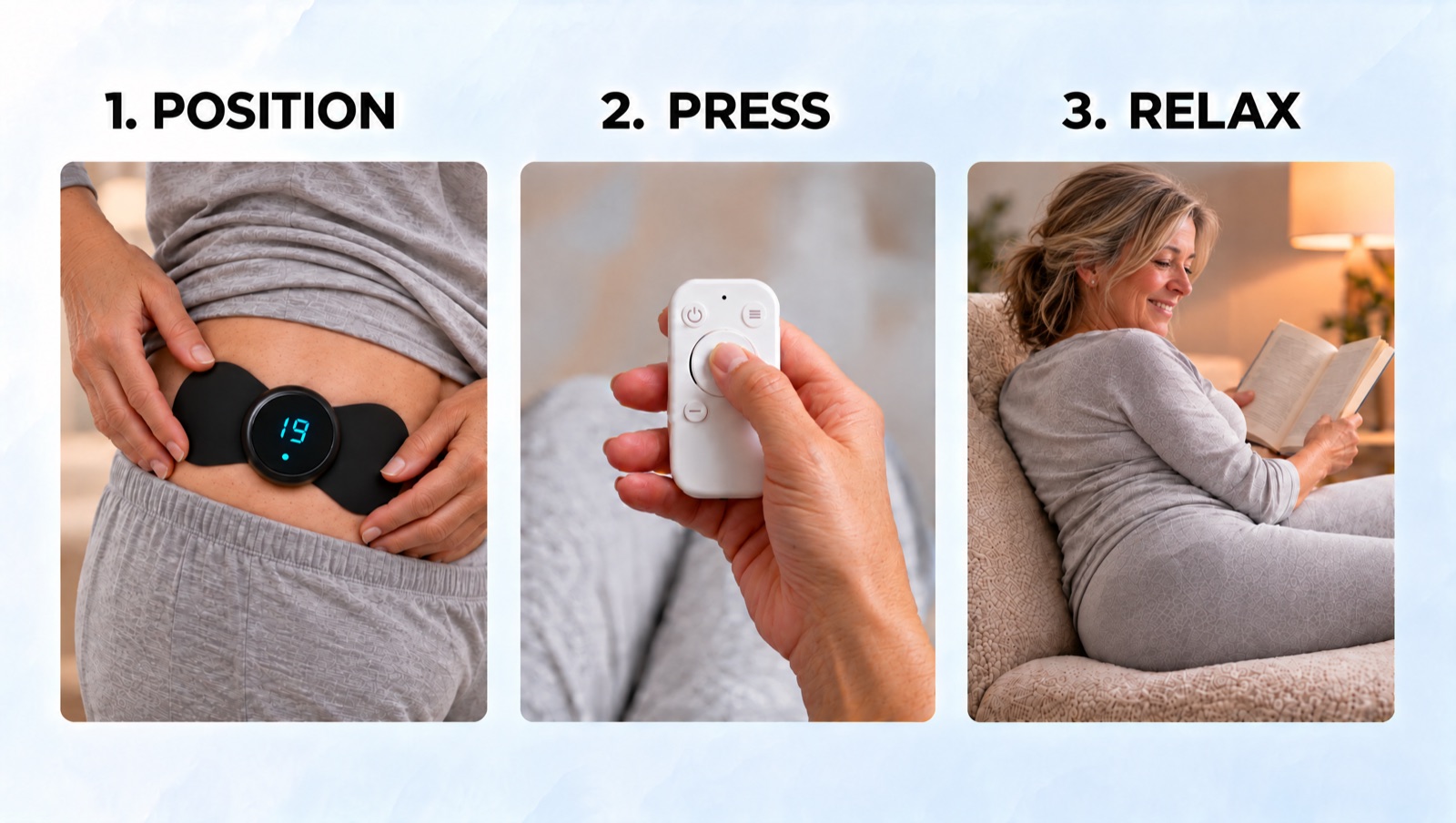
Position the device over your hip. Press the button. Sit back. It runs the session and switches itself off. No gels to mix, no appointments, no learning curve. If you can operate a television remote, you can run your own protocol.
Start Your 90 Day Protocol TonightThen Her Walking Group Found Out
Carol talks. It's one of the reasons I married her. Within a month, the women in her walking group, the same group she had quietly quit two years earlier, wanted to know what changed. Then their sisters called. Then their book clubs.
I started getting emails forwarded from women I had never met, all telling some version of the same story: the labels collected over the years, the drawer full of failed devices, the first night of real sleep. That is when I decided this page needed to exist. Not every woman has a surgeon at the dinner table.
What Women Are Experiencing
I will not pretend every story is Carol's story, and anyone who promises you that is selling something. But certain sentences now repeat so often, from so many women, that I can tell you the order they arrive in. Sleep first. Then mornings. Then the day you have to think, genuinely think, to remember which side was the bad one.



The Letters Started Arriving
Since this page went live, I have been told three times, politely and through lawyers, that it would be better for everyone if it came down. The device has no billing code, they say. It is not part of any approved protocol, they say.
An attorney friend read the letters and laughed. Letters like these are never about safety. They are about revenue. When a woman cancels her third injection appointment because she is holding a device that costs less than one copay, someone, somewhere, stops getting paid.
I recognize the playbook because I spent 26 years inside it. The loop is the business model: manage the tendon, repeat the tendon, schedule the tendon. They do not want you out of the loop, because the loop is where the money lives.
Then a distributor that rents red light panels to clinics called the company directly. Their complaint was almost honest: at this price, they said, you are destroying the perceived value of light therapy.
They are right. It is being destroyed. Because perceived value never switched a single muscle back on.
That is why the current batch is still sold directly, at a fraction of the clinic price, while units last. And I will be straight with you about the future: the company keeps sourcing components and shipping orders, but if one of these letters ever lands in the wrong courtroom, this page disappears along with the stock.
>>> CHECK IF CORERESET IS STILL IN STOCK <<<The Line You Don't Want to Cross
There is one more thing, and it is the reason I never tell anyone to "think about it for a few months."
A muscle that stops firing does not wait politely. The longer the pathway stays quiet, the deeper the inhibition sets, and the more the tendon pays for it, every step, every night. The women who came to me after a decade of managing took the longest to bring back. Not because the device works slowly. Because their Guardians had been off duty so long that the rebuild had further to go.
If the Guardian stays off duty: six months from now, another flare from nothing. A year from now, another round of "let's try the injection again." Two years from now, someone mentions the word surgery for a tendon that was never the root of anything, and you start organizing your life around a body you no longer trust.
If it wakes up: four weeks, real nights of sleep. Two months, walks without the aftermath. Six months, you've forgotten which side was the bad one.
Same tendon. Same starting point. The only difference is whether its bodyguard comes back to work, and how long you make it wait.
My Honest Recommendation
You have already spent the money and the years on everything that works around the problem. You know the ledger by heart: the loading program that demanded strength from a muscle that was not firing, the injections that bought a few weeks, the shockwave, the TENS, the red light, the powders. All of it aimed at the victim. None of it at the cause.
CoreReset costs less than a single copay on the treatments that failed you, because the team behind it sells directly on this page instead of through clinics. It is not for everyone. If you have a pacemaker or an implanted electrical device, if you are pregnant, or if you would place it over an active tumor or a known blood clot, do not use it. Everyone else can try it the way medicine should always be tried: with the risk on us, not on you.
Try It Risk Free Tonight

I told the company I would put my name on this page under one condition only: the guarantee has to outlast your skepticism. And after everything you've been through, you have earned the right to be skeptical.
Use CoreReset for 90 days. Fifteen minutes a day. If the lockout doesn't break, if your nights don't change, if your mornings don't get easier, one email gets you every penny back. No forms. No "store credit." No questions.
You either wake the Guardian, or it costs you nothing.
The Questions Women Ask Me Before They Start
I've done tendon loading for months. Why would this be any different?
Because loading demands strength from a muscle that isn't firing, which is why it exhausted you and changed nothing. CoreReset forces the Guardian to contract first, rebuilds the pathway between brain and muscle, and then loading work can finally stick. Many women keep their exercises. They just start working for the first time.
What about shockwave, red light therapy, or another injection?
All three work on the tissue at the surface or on the tendon itself, while the muscle that failed stays switched off. Wake the bodyguard first. The tendon finally gets the quiet it needs to heal.
How is this different from the TENS unit in my drawer?
Depth and purpose. TENS distracts surface nerves a few millimeters down. The Guardian sits thirty to fifty millimeters deep, and TENS literally cannot reach it. One masks the pain. The other wakes the muscle.
Is it safe? Any side effects?
NMES has been used in clinical rehabilitation for over 40 years. The pulses are gentle and drug free, with no interactions with your prescriptions. If you have a pacemaker or any implanted electrical device, if you're pregnant, or if you'd place the pads over an active tumor or a known blood clot, this isn't for you. Otherwise, it's safe for virtually everyone.
How fast will I feel it?
The deep pulse, the very first session: a slow contraction inside the muscle, nothing like a surface buzz. Most women report their first real nights of sleep inside the first two weeks. The full pathway rebuild takes about 90 days. That's exactly why the guarantee lasts 90 days.






Stop Rehabbing the Victim. Wake the Guardian.
Start Your 90 Day Protocol Tonight
- Reaches the Guardian at 30 to 50mm deep
- 15 minutes a day, at home
- Drug free, 40 years of clinical use
- 90 day money back guarantee